Link Building in the AI Era: Why Quality and Consistency Are Your Only Safety Nets
For over two decades, backlinks have been the backbone of Search Engine Optimization (SEO). They are the fundamental currency of the web, acting as a vote of confidence from one site to another, signaling to Google that your content is trusted, authoritative, and relevant.
However, the digital landscape is shifting. With the rise of Artificial Intelligence (AI) and Generative AI Overviews, the way users search and the way Google retrieves information is changing fundamentally. This begs the question: Is link building still relevant?
The short answer is yes. In fact, it is arguably more relevant now than ever before.
As AI dramatically lowers the barrier to content creation, the web is becoming flooded with average, machine-generated text. The value of “content” on its own is declining because supply is infinite. However, the one signal that AI cannot easily fake or replicate is a genuine, high-quality backlink profile.
In this guide, we will explore the modern philosophy of link building, why quality trumps quantity, and why “stopping” your campaign is the most dangerous thing you can do for your business.
The New Reality: Trust Signals in a Sea of AI Content
We are moving into an era where Google’s search results are often answered directly by AI overviews. For a website to be cited in these overviews, or to rank below them, “Authority” is the deciding factor.
Because AI can generate thousands of words in seconds, Google can no longer rely solely on on-page content to determine expertise. Anyone can publish a comprehensive guide now. But not everyone can earn a mention from a reputable industry publisher or a trusted news site.
Link building has evolved from a “ranking hack” into a vital verification layer. It is the primary way Google distinguishes between a generic, AI-spun website and a legitimate business that is active in the real world.
The “Quality vs. Quantity” Debate
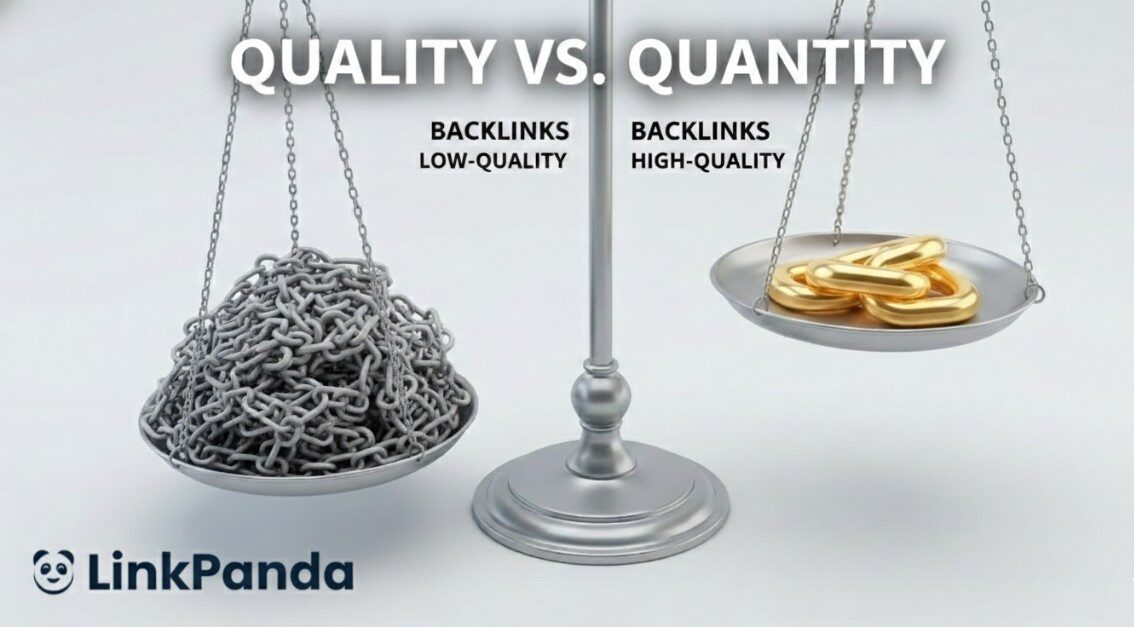
There has always been a conflict in the SEO industry: what matters more, the volume of links or the quality of the source?
Our agency’s philosophy, and the data supports this, is that quality is the clear winner.
The Magic Number: 10 to 20 Links Per Month
You do not need to acquire hundreds of links every month. In fact, doing so can often look suspicious (more on that later). For most businesses, the “sweet spot” is a consistent acquisition of 15 to 20 high-quality links per month.
While 15 links might sound low compared to the “blast” strategies of the past, consider the compound effect:
- Month 1: 15 links
- Month 12: 180+ active, high-authority links.
That is a formidable backlink profile. Furthermore, there is a flywheel effect at play here. When you actively acquire 20 new mentions, you increase your visibility. As your visibility grows, the rest of the web starts to notice you.
Organic mentions beget more organic mentions. By manually securing those first 20 spots, you trigger a natural cycle where other sites start linking to you without you asking. It is a winning formula where your active efforts are amplified by organic growth.
Collaborative Strategy: Data Meets Business Logic
One of the biggest pitfalls in link building is agencies working in a silo, looking only at SEO metrics. To make a campaign successful, we need to bridge the gap between data and business logic.
As an agency, we have access to incredible tools. We can analyze:
- Search volume and demand.
- Keyword difficulty.
- Competitor backlink gaps.
- Region-specific demand (e.g., specific trends in the UK vs. the US).
However, data has a limit. We cannot understand the ins and outs of your business better than you do. We don’t know which product has the highest profit margin, which service has the best customer retention, or which inventory you need to move now.
The Strategy Handshake
The most effective campaigns happen when the client tells us, “These are the 5 pages we care about most.”
Once we have that component covered, which is the business intent, we can shape the entire SEO strategy around it. We essentially wrap our technical expertise around your commercial goals. This ensures that we aren’t just driving “traffic” for vanity metrics, but driving authority to the pages that impact your bottom line.
Managing Expectations: The Timeline of Trust
A common question we face is: “How soon will we see results?”
It is important to differentiate between technical impact and ranking impact.
- Technical Impact (Days): Google is incredibly fast at crawling the web. If we secure a high-quality link for you on Tuesday, Google will likely crawl it and index it by Thursday. You might see a slight fluctuation in impressions almost immediately.
- Ranking Impact (Months): SEO is a long-term game. Trust is not built overnight. Just because Google sees the link doesn’t mean it immediately re-ranks your entire site.
The 3-Month Rule
We advise all clients to set their mindset to a three-month horizon minimum. This is the realistic window to start seeing meaningful growth in organic positions.
If you enter a campaign expecting overnight miracles, you will be disappointed. If you enter with the understanding that you are building a digital asset that matures over time, you will stay motivated and focused enough to see the ROI materialise.
Safety First: Avoiding the “Spam” Label
In the world of link building, there is a safe way, and there is a careless way. The difference often comes down to intent and patterns.
Google’s algorithms are essentially pattern-matching machines. They are looking for footprints that suggest manipulation.
The “Spam” Pattern
- Velocity: Building 500 links in week one for a site that usually gets zero.
- Anchors: Using the exact same commercial keyword (e.g., “best running shoes”) for every single link.
- Targeting: Pointing every single link to one money page and ignoring the rest of the site.
The “Safe” Approach
Our approach is designed to mimic natural popularity:
- Manual Outreach: Every link is hand-picked and negotiated.
- Steady Velocity: 10–20 links a month looks like steady, organic growth.
- Diverse Anchors: A mix of brand names, natural phrases, and keywords.
When you selectively choose the sites you want to be featured on, you are on the safe side. It effectively ceases to be “manipulation” and becomes “Digital PR” or “strategic placement.”
The “Stop” Button: Why You Can’t Just Switch It Off
A common misconception is treating SEO like a project with a finish line. “We hit Page 1, so we can stop spending money on links now.”
This is a dangerous mindset.
The “Freshness” Factor
Google isn’t just looking for who has the most links; it is looking for who is relevant right now.
If your site acquired 200 links in 2024 and zero links in 2025, that signals to Google that your business is no longer a topic of conversation. You are “stale.”
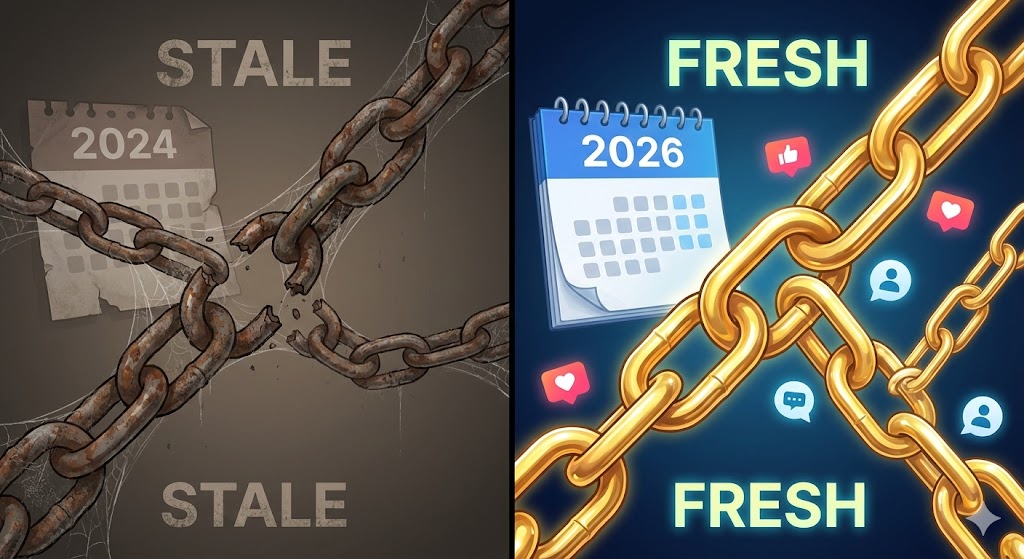
To maintain rankings, you need fresh signals. Google needs to see that people are still talking about you. This extends beyond just blogs; it includes activity on:
- Review platforms.
- User-Generated Content sites (Reddit, Quora)
- Social media.
If the chatter stops, the rankings drop. A consistent, “always-on” campaign, even at a lower volume, is far superior to a massive burst followed by silence.
In-House vs. Agency: The Resource Dilemma
Can companies do this themselves? Absolutely. There is no secret “magic button” that only agencies possess. However, the reality of execution is difficult.
Link building is, by nature, a monotonous, grinding task.
- You must prospect thousands of sites.
- You must find the right contact emails.
- You must chase, follow up, and negotiate.
- You must write the content and ensure it gets published.
For an in-house team, this quickly becomes a full-time job for multiple people. It is easy for an in-house marketing manager to get distracted by other tasks, leading to inconsistent link velocity.
The ROI of an agency comes from specialization and consistency. We take the stress off your shoulders. We are responsible for hitting the targets. You receive a measurable outcome (ROI) without having to manage the tedious day-to-day operations of outreach.
Conclusion: Focus on the Main Goal
Ultimately, link building can be done in various ways. You can aim for brand awareness, referral traffic, or digital PR buzz.
However, in the early stages, it pays to be single-minded. The primary goal should be building Authority to assist your site in growing rankings. That is a perfectly sufficient goal.
While visibility and branding are nice bonuses, the core objective is to signal to Google that your site is a trusted entity in a world of AI noise. By focusing on quality sites, maintaining a steady pace, and collaborating on business priorities, you build a defensive moat around your business that competitors and AI cannot easily cross.
Discover LinkPanda AI SEO Services
Frequently Asked Questions
Topical FAQ
LinkPanda Service FAQ
About The Author

Christopher Lier
Christopher is an experienced Search Engine Optimization (SEO) marketer and digital marketing specialist. He is Co-Founder of LinkPanda and leads the marketing and sales teams. Mostly known as a Software-as-a-Service co-founder of LeadGen App, he has helped grow the website to become a renowned player in the lead generation space with steadily growing user base and readership.