Generative AI search gives buyers a written answer instead of a list of links. Google AI Overviews, Google AI Mode, ChatGPT search, Perplexity and Gemini all work this way: they read several sources, write a summary and cite a handful of pages.
For a business, the question changes from “do we rank?” to “are we named in the answer?” This guide explains how generative AI search works, how it picks its sources and what you can do to get your brand cited.
Key Point: Generative AI search rewards the same things good SEO does, pages search engines can crawl and trust, plus one more: being named on the third-party pages AI tools read when they build an answer.
What Is Generative AI Search?
Generative AI search is any search experience where an AI model writes the answer. Instead of ten blue links, the user gets a summary with a few cited sources and can ask follow-up questions.
The main generative AI search tools are:
- Google AI Overviews: AI summaries shown at the top of normal Google results.
- Google AI Mode: A chat-style search inside Google for longer, more complex questions.
- ChatGPT search: Launched by OpenAI on 31 October 2024, with links to sources under each answer1.
- Perplexity: An answer engine that cites its sources inside the answer.
- Gemini and Microsoft Copilot: Assistants that search the web when a question needs current information.
How Generative AI Search Differs From Traditional Search
| Traditional Search | Generative AI Search | |
|---|---|---|
| What the user sees | A ranked list of pages | A written answer with a few cited sources |
| How people search | Short keywords | Longer questions and follow-ups |
| Clicks | Most visits go to the top results | Many questions are answered without a click, so the brands named in the answer get the attention |
| What success looks like | Rankings and clicks | Mentions, citations and share of voice in answers |
How AI Answers Choose Their Sources
Google says a page must be indexed and eligible to show in Search with a snippet to appear as a supporting link in AI Overviews or AI Mode, and that there are no extra technical requirements2.
Query Fan-Out: Why One Question Becomes Many Searches
Both Google features can use “query fan-out”. They split one question into several related searches across subtopics and pull in more pages while they write the answer.
Take a buyer who asks “what is the best CRM for a 10-person sales team?” Behind the scenes, the AI may also search for CRM pricing for small teams, CRMs with email integration and comparisons of the leading tools. Pages that answer those sub-questions well can be pulled into the final answer, even if they do not rank for the original question.
How query fan-out works
For your content, this means covering the follow-up questions around your main topic, not just the headline keyword. Pricing, comparisons, integrations and use cases all give AI tools more reasons to use your pages.
In practice, three things decide whether your brand is cited:
- Your pages can be found and read. They are crawlable, indexed and state the key facts in plain text.
- Your site is trusted. Authority still comes largely from links and from being mentioned by reputable sites. In a 2025 Editorial.link survey, 73.2% of SEO practitioners said backlink authority affects which sources AI search engines cite4.
- Your brand appears on the pages AI tools already read. For most categories these are best-of lists, reviews, comparison articles and forum threads.
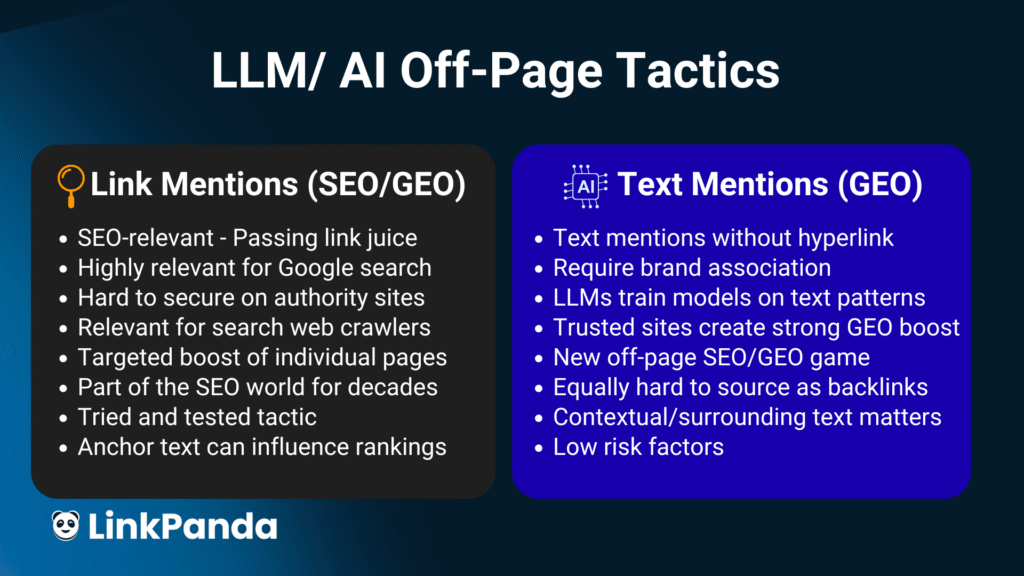
What Is Generative Engine Optimization (GEO)?
Generative engine optimization, or GEO, is the work of making a brand more likely to be cited in AI-generated answers. The term comes from a 2023 research paper led by Pranjal Aggarwal.
The paper found that changes such as adding citations, quotes and statistics could raise a source’s visibility in generative engine responses by up to 40%3.
GEO does not replace SEO. It builds on it, because the pages AI tools cite are usually pages search engines already rank and trust. LinkPanda’s AI SEO services cover both.
How to Get Your Brand Cited in Generative AI Search
- List the questions your buyers ask. Include “best X for Y” questions, comparisons and pricing questions for your category.
- Check where you stand today. Run those questions in ChatGPT, Perplexity, Gemini and Google, and note which brands and pages are cited. An AI visibility audit does this across a full set of buyer questions.
- Answer those questions plainly on your own pages. Use clear headings, direct answers and concrete facts such as who you serve, what you offer and what it costs. Add FAQs with matching FAQ schema.
- Make sure AI crawlers can read your site. Check that robots.txt allows GPTBot, ClaudeBot and PerplexityBot, and that key content is in text rather than images. The free AI SEO score checks this in a minute.
- Get named on the pages AI tools cite. Placements in relevant best-of lists and reviews put your brand inside the answer itself.
- Keep building authority. Relevant links from trusted sites help you rank, and ranking pages are the ones AI tools draw on.
- Track and repeat every month. AI answers change often, so check the same questions regularly.
Real Examples: Brands Growing in AI Search
The steps above are what we use with clients. Three LinkPanda campaigns show how placements on the pages AI tools read turn into visibility.
LinkPanda campaign results
Blank Spaces: 15x More AI Citations in One Quarter
Blank Spaces is a screen time app with more than one million installs. Buyers in its category ask AI assistants for the best screen time app or app blocker, so we secured 10 placements on high-authority listicle sites (average DR 68) in one quarter.
Monthly AI citations grew from 10 to 151, a 15x increase, across Google AI Overviews, ChatGPT, Grok and Perplexity. Referring domains rose from 140 to 465 over the same period5. Read the Blank Spaces case study.
ZeroGPT: 4.4x Traffic in a Crowded AI Category
ZeroGPT is one of the best-known AI content detectors. We placed it in AI detector roundups and comparison posts and built 14 links to its newer tools, such as the paraphraser and summarizer.
Monthly visits grew from 2.2 million to 9.7 million, a 4.4x increase, and referring domains rose from 2,321 to 4,4206. Those roundups are exactly the pages AI assistants read when someone asks for the best AI detector. Read the ZeroGPT case study.
Zeely: 5.6x Organic Traffic for a Newer Brand
Zeely is an AI marketing app for small businesses, competing with much larger brands. We placed it in AI marketing tool roundups and built 12 links to its feature pages.
Organic traffic grew 5.6x, referring domains rose from 146 to 279 and Domain Rating went from 39 to 487. Growth like this gives AI tools more trusted pages that name the brand. Read the Zeely case study.
How to Measure Your Visibility in Generative AI Search
Rankings alone no longer tell you how visible you are. These are the measures we track for clients.
Five measures of AI search visibility
Prompt Tracking
Prompt tracking means running a fixed set of buyer questions through each AI tool on a regular schedule and recording the answers. A good set covers your main products, your category’s “best X” questions and comparisons with competitors.
AI answers change from one run to the next, so repeat each prompt several times and look at the trend over weeks, not a single result.
Mentions and Citations
A mention is when the answer names your brand. A citation is when the answer links to one of your pages as a source. You can be mentioned without a link, or cited for a fact without being recommended, so track both.
Sentiment and Position
Sentiment measures how the answer describes you: positive, neutral or negative. Position measures where you appear, for example named first as the top pick or listed last.
If answers describe you badly, look at the sources they cite. Outdated reviews or old comparison articles are often the cause, and fixing or replacing them changes the answer.
Share of Voice
Share of voice compares your mentions with your main competitors across the same prompts. It shows whether you are gaining ground in your category, not just whether you appear.
AI Referral Traffic and Leads
In Google Analytics, track visits from chatgpt.com, perplexity.ai, gemini.google.com and copilot.microsoft.com, and the enquiries they bring. This ties AI visibility to pipeline.
For the metrics that predict discovery, see our guide to AI search visibility for SaaS. For tracking tools, see the best AI SEO tools.
Find Out If AI Tools Mention Your Brand
We test your buyers’ questions in ChatGPT, Perplexity, Gemini and Google AI Overviews and show you where you stand.
Frequently Asked Questions
LinkPanda Link Building: Frequently Asked Questions
The sources below back up the data and quotes used in this guide.
External Sources

OpenAI Introducing ChatGPT search
Announces the launch of ChatGPT search on 31 October 2024, with links to sources in each answer.
Google Search Central AI features and your website
Google explains how AI Overviews and AI Mode select supporting links and confirms there are no extra technical requirements.
arXiv GEO: Generative Engine Optimization
The 2023 paper by Aggarwal and colleagues that introduced GEO and reported visibility gains of up to 40%.
Internal References

LinkPanda 73.2% believe backlinks influence AI search visibility
LinkPanda Research summary of the Editorial.link 2025 practitioner survey.
LinkPanda How Blank Spaces Grew AI Citations From 10 to 151
LinkPanda case study: 10 listicle placements in one quarter and a 15x rise in monthly AI citations.
LinkPanda ZeroGPT: 4.4x Traffic Growth to 9.7M Visits
LinkPanda case study: listicle placements and 14 links for an AI detection tool.
LinkPanda Zeely.ai: 463% Organic Traffic Surge
LinkPanda case study: 12 links and AI marketing roundup placements for a newer brand.
About The Author

Christopher Lier
Christopher is an experienced Search Engine Optimization (SEO) marketer and digital marketing specialist. He is Co-Founder of LinkPanda and leads the marketing and sales teams. Mostly known as a Software-as-a-Service co-founder of LeadGen App, he has helped grow the website to become a renowned player in the lead generation space with steadily growing user base and readership.
You May Also Like
SEO Experiments: How We Test What Actually Moves Rankings at LinkPanda
Brand Mentions for SEO: How to Earn More for AI Search
Link Reclamation: How to Find and Recover Lost Backlinks
23 Best Tech Startups in Finland: The Nordic’s Startup Hall of Fame
Best Enterprise SEO Agency Picks for 2026
Best AI SEO Tools for 2026 (Reviewed and Compared)
Best Link Building Tools for 2026 (Reviewed and Compared)
Top SEO Companies & Agencies in the USA