A Honest Look at the Tactics That Live Between Safe and Risky SEO

Can you boost your site’s rankings without fully committing to either safe, slow white hat SEO or the outright rule-breaking of black hat tactics? Grey hat link building promises exactly that: faster results through methods that operate in the grey areas of search engine guidelines.
But what feels like a clever shortcut today can become a liability tomorrow. Grey hat strategies can deliver real gains, but they carry genuine risk if search engines catch on. This guide breaks down what grey hat link building actually is, which tactics fall under it, and how to decide whether the potential reward is worth the long-term exposure.
What Makes a Link-Building Technique “Grey Hat”?
Grey hat link building sits between white hat (fully ethical, guideline-compliant) and black hat (deliberate rule-breaking). These strategies operate in the ambiguous middle ground where search engine policies are unclear, loosely enforced, or easy to exploit without obvious violation.
Used sparingly, some grey hat techniques may go unnoticed or even be tolerated. Used at scale, they become a liability. Search engines are increasingly sophisticated at detecting patterns that suggest manipulation, and sites that cross that threshold risk manual penalties, algorithmic downgrades, or deindexing.
Beyond the technical risk, grey hat practices raise legitimate questions about long-term brand reputation. Competitive industries often push businesses toward these tactics, but the calculus changes depending on how much you value brand trust and how much risk your business can absorb.
Black Hat vs. White Hat vs. Grey Hat: What’s the Difference?
Pros and Cons of Grey Hat Link Building
Pros
Faster results. Grey hat techniques often exploit loopholes in search engine algorithms, allowing for quicker ranking movement compared to strictly white hat strategies.
Flexibility. These methods open up more creative approaches, particularly in competitive niches where white hat tactics alone may be too slow to gain traction.
Short-term momentum. When executed carefully, grey hat strategies can deliver early boosts in site authority and traffic, which can be valuable for newer sites trying to establish a foothold.
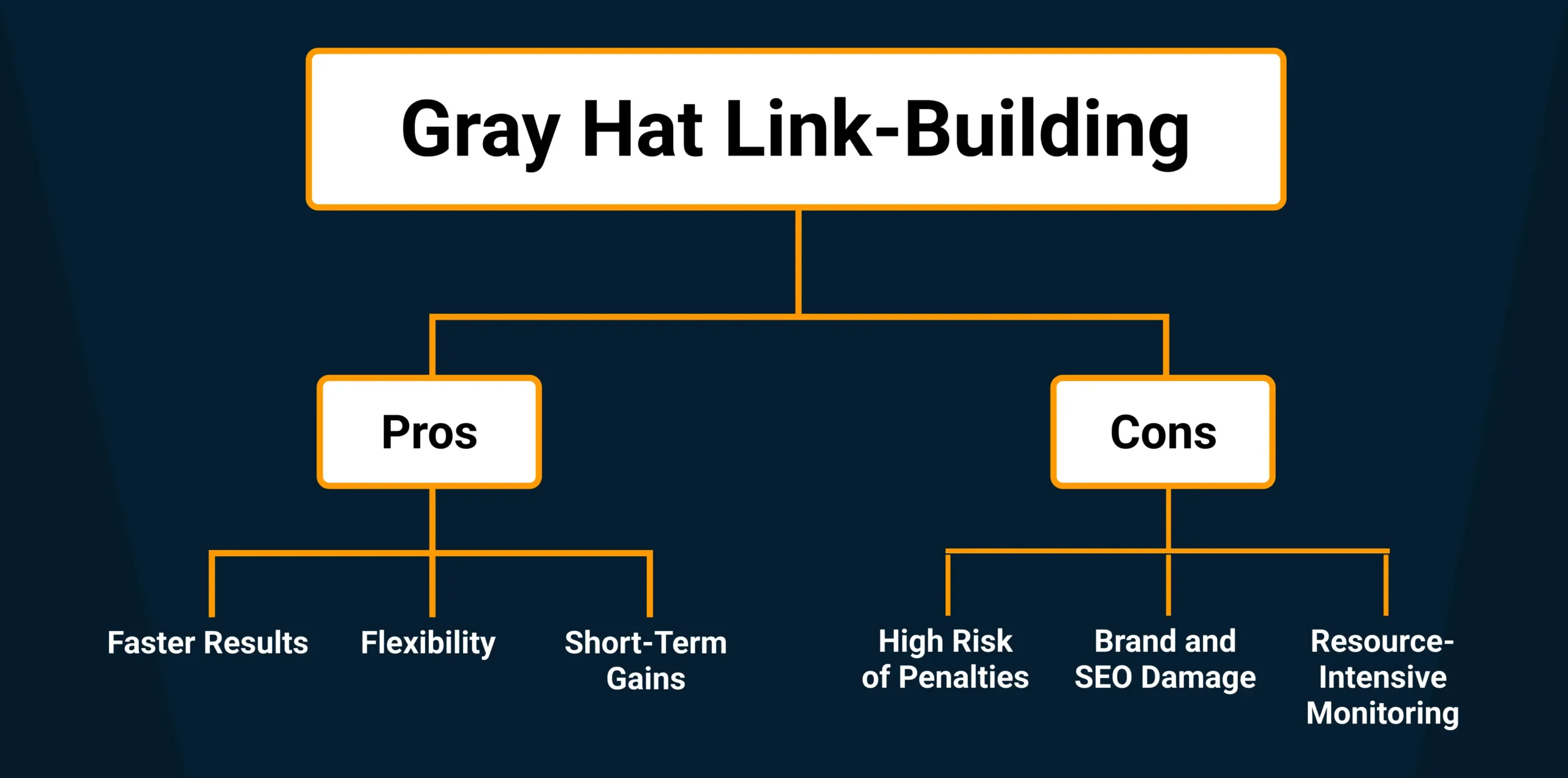
Cons
Penalty risk. Google can impose manual penalties, trigger algorithmic downgrades, or deindex your site entirely if manipulative link patterns are detected.
Brand and SEO damage. Penalties do not just hurt rankings in the short term. They can damage your brand’s credibility in ways that are slow and difficult to recover from.
Resource-intensive monitoring. Grey hat tactics require ongoing auditing to ensure link quality stays high and patterns do not become detectable. That ongoing overhead is easy to underestimate.
Grey Hat Link Building Techniques
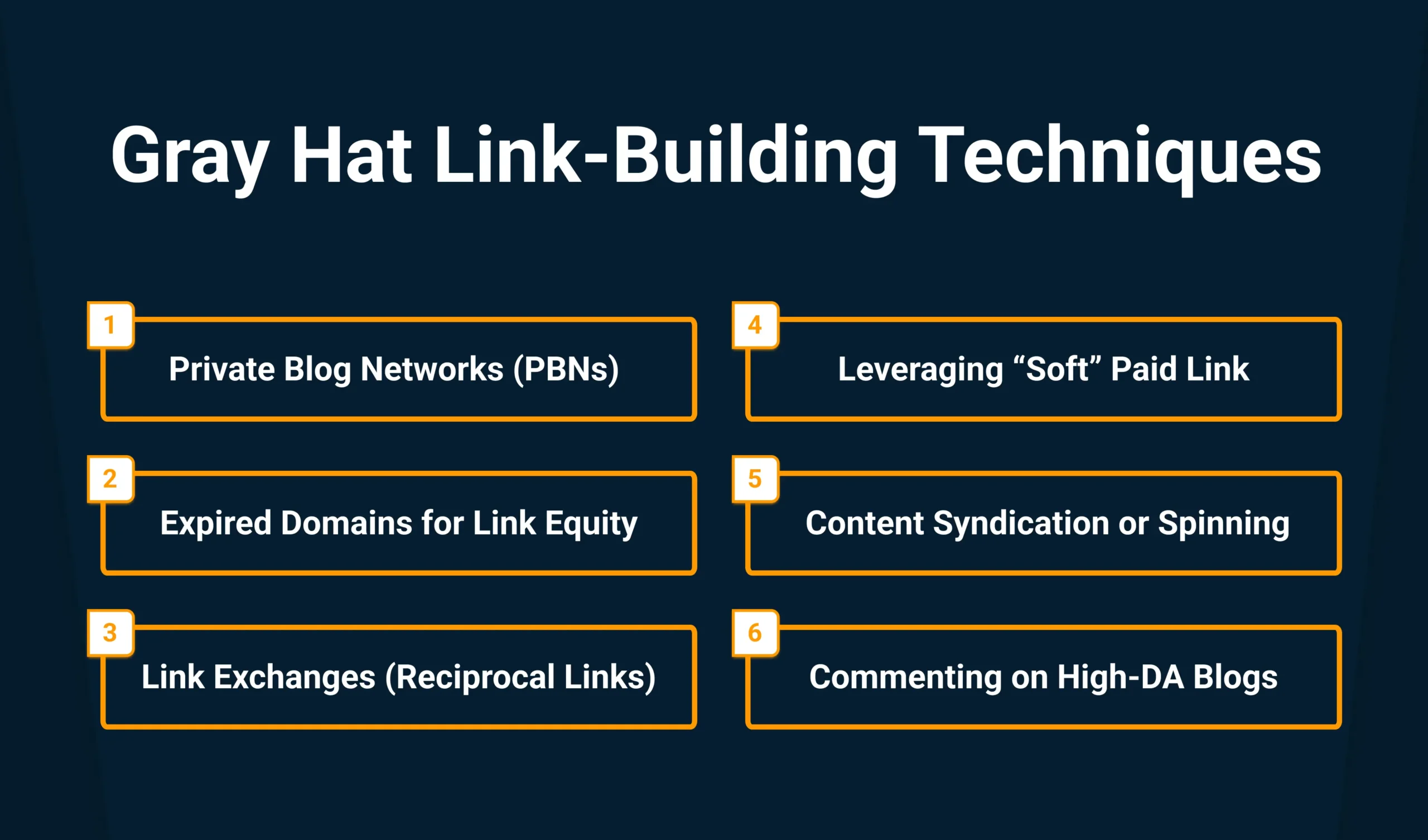
Private Blog Networks (PBNs)
A PBN is a network of websites built specifically to link back to a central site, artificially inflating its authority and rankings. The owner controls anchor text and linking domains, making keyword targeting straightforward.
The risk is significant. Search engines actively penalize PBNs, and maintaining one requires each site to have unique content and regular updates to avoid detection. If the network is discovered, both the PBN sites and the main site face severe penalties or deindexing.
Expired Domains for Link Equity
Buying expired domains with existing backlinks and redirecting them to your site is a way to quickly inherit link equity. If the expired domain has relevant, high-quality backlinks, the authority transfer can be meaningful.
The downside is that Google may penalize sites using unrelated redirects, and keeping an expired domain’s authority alive requires continuous content investment, adding long-term maintenance costs.
Link Exchanges (Reciprocal Links)
Reciprocal linking involves two sites agreeing to link to each other for mutual benefit. It is simple, low-cost, and can work well between sites in related niches.
The problem is scale. Done occasionally and naturally, reciprocal links are unlikely to cause issues. Done excessively, search engines may flag the pattern as manipulative and penalize both parties.
“Soft” Paid Links
Rather than buying links outright, some marketers pay for sponsored content that includes a backlink, making the link appear more organic. When sourced from reputable sites, these can be harder for search engines to detect.
The catch is that Google prohibits paid links without proper disclosure (rel=”sponsored”). If detected, both the buying and selling sites risk penalties and credibility damage.
Content Syndication and Spinning
Republishing articles on multiple platforms or rewriting content for reposting can generate backlinks across various sites at relatively low cost.
The risk is duplicate content, which can harm rankings. Poorly executed syndication also tends to produce low-quality backlinks that drag down rather than lift your site’s authority.
Commenting on High-DA Blogs
Leaving relevant, insightful comments on high-DA blogs with a link back to your site can generate backlinks and drive traffic. When comments add genuine value, this approach can support authority building.
Most high-DA blogs use nofollow attributes on comment links, which limits SEO value. And spammy, low-effort commenting does real damage to your brand’s reputation.
When to Avoid Grey Hat Tactics Entirely
Grey hat link building is not a universal fit. There are clear scenarios where the risk simply is not worth it:
High-scrutiny industries. Healthcare, finance, and legal sectors face greater regulatory and algorithmic scrutiny. Manipulative practices in these niches are more likely to attract penalties.
Reputation-first businesses. If your brand’s credibility is a core asset, the potential reputational fallout from a penalty outweighs any short-term ranking gain.
Long-term growth focus. If sustainable growth and brand trust are your primary goals, grey hat shortcuts tend to work against you more than they help.
Best Practices If You Do Use Grey Hat Techniques
Diversify your link profile. Never rely solely on grey hat links. Supplement with organic, white hat links to balance your profile and reduce the risk of triggering detection.
Monitor backlinks regularly. Audit your backlink profile consistently to catch low-quality or penalized links early before they compound into a bigger problem.
Use sparingly. Overuse is the primary trigger for penalties. Grey hat techniques used at low volume and in natural-looking patterns are far less likely to draw scrutiny.
Prioritize contextual relevance. Whether through syndication or exchanges, always ensure your links are placed naturally within relevant, high-quality content. Relevance reduces the likelihood of a link appearing manipulative.
Frequently Asked Questions
What are zombie pages in SEO? Zombie pages are pages on a website that generate minimal to no traffic and are effectively invisible in search results. They add bloat without contributing value.
What are orphan pages in SEO? Orphan pages are pages not linked to from anywhere else on the site, making them hard for both users and search engines to discover.
Are doorway pages good for SEO? No. Doorway pages are low-quality pages created to rank for specific keywords and funnel users toward the same destination via multiple paths. Search engines consider them manipulative and penalize sites that use them.
What is the difference between black hat and grey hat SEO? Black hat SEO deliberately violates search engine guidelines, risking immediate and severe penalties. Grey hat SEO bends the rules without outright breaking them, offering faster results but still carrying real penalty risk when overused or detected.
Final Thoughts
Grey hat link building occupies a complicated space in SEO. The tactics can work, and in competitive niches, the temptation to use them is understandable. But the risks are real, and the cost of a penalty extends beyond rankings to long-term brand credibility.
If you do use grey hat techniques, use them deliberately, sparingly, and always alongside a strong foundation of white hat link building. And if you would rather not play that game at all, there are proven ethical strategies that deliver lasting results without the exposure.
At LinkPanda, we build link strategies designed around your specific goals, whether that means purely white hat approaches or a carefully considered hybrid. From outreach and guest posts to digital PR, every link we build is earned through methods that strengthen your site for the long term. Get in touch to find out how we can help.
About The Author

Anaan Masoodi
A skilled link builder specializing in ethical SEO practices, Anaan focuses on acquiring high-quality backlinks that enhance website authority and search rankings. With a deep understanding of digital marketing strategies, he leverages outreach, guest posting, and content-driven approaches to build valuable relationships and drive sustainable growth for businesses.