Why Digital PR and SEO No Longer Work in Silos
There was a time when public relations and search engine optimisation lived in separate departments, reported to separate managers, and measured success in entirely different ways. PR counted column inches and media impressions. SEO tracked rankings and organic sessions. Neither team talked much to the other, and both strategies were weaker for it.
That era is definitively over. In 2026, digital PR and SEO have converged into one of the most powerful combinations available to marketers. When a respected publication covers your brand and links to your site, it moves your rankings. When your content earns editorial placements on high-authority domains, it builds the kind of trust that Google’s algorithm is specifically designed to reward.
The evidence is no longer anecdotal. BuzzStream’s 2026 State of Digital PR Report found that 53.4 percent of digital PR professionals now work most closely with SEO teams, up from 50.9 percent the previous year. The brands treating digital PR and SEO as a unified strategy are pulling decisively ahead of those that still keep them in separate silos.
This guide draws on the latest 2026 research, including BuzzStream’s State of Digital PR Report, Cision’s Inside PR 2026 Report, and data from Reboot Online, Muck Rack, New Media, and Motive PR, to give you a clear, practical picture of what digital PR and SEO look like when they work together properly.
What Is Digital PR?
Digital PR is a strategy for building a brand’s online visibility, authority, and reputation through earned media coverage, high-quality backlinks, brand mentions, and storytelling across digital channels. It takes the core principles of traditional public relations, managing reputation, building relationships with journalists, crafting compelling narratives, and applies them to the measurable, trackable world of online marketing.
Where traditional PR focused on securing placements in newspapers, broadcast television, and trade magazines, digital PR targets online publications, industry blogs, news sites, podcasts, and digital media outlets. The goal is the same: get your brand in front of the right audiences through channels they already trust. The fundamental difference is that every placement, mention, and backlink in digital PR can be measured, tracked, and connected directly to business outcomes.
Cision’s Inside PR 2026 Report, based on responses from nearly 600 PR professionals across the US and UK, confirms this shift. The lines between public relations and SEO have never been blurrier, and the brands that understand how to use both together have a meaningful competitive advantage.
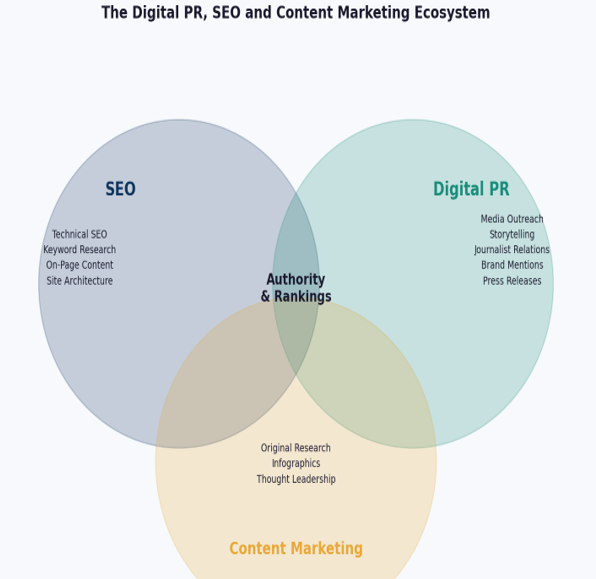
How Digital PR, SEO, and Content Marketing intersect to build online authority
Digital PR vs Traditional PR
Traditional PR and digital PR share the same DNA but produce very different outcomes. Traditional PR is difficult to measure, relies on offline media, and tends to fade after the coverage cycle ends. Digital PR is built for permanence. A backlink earned through a well-executed digital PR campaign continues to pass authority to your site for years. A brand mention in a major online publication stays indexed and discoverable indefinitely.
The other critical difference is targeting precision. Traditional PR casts wide and hopes for relevance. Digital PR is deliberate: you identify the specific publications your audience reads, the journalists who cover your space, and the stories that resonate with both the media and search algorithms. This precision is what makes digital PR for SEO so effective.
Digital PR vs Link Building
Digital PR and link building are closely related but they are not the same thing. Link building focuses specifically on acquiring backlinks, often through outreach, resource pages, and guest posting. Digital PR is broader. It uses newsworthy content, original research, data-led campaigns, and expert commentary to earn coverage that naturally includes backlinks as a byproduct.
The distinction matters because digital PR consistently produces higher-authority links. Reboot Online’s analysis found that the average Ahrefs Domain Rating of a digital PR backlink is 61, with more than one in five links sitting in the DR 70 to 79 range. That is an authority level that most conventional link building tactics cannot reach at scale.
How Digital PR Directly Impacts SEO Performance
To understand the connection between digital PR and SEO, you need to understand what search engines are actually trying to measure. Google wants to surface content from sources that are genuinely authoritative, trustworthy, and relevant. Links and brand mentions from reputable third-party sources are the clearest external signals it has that a brand deserves to rank.
Digital PR for SEO generates exactly those signals, at a quality level that conventional link building cannot replicate.
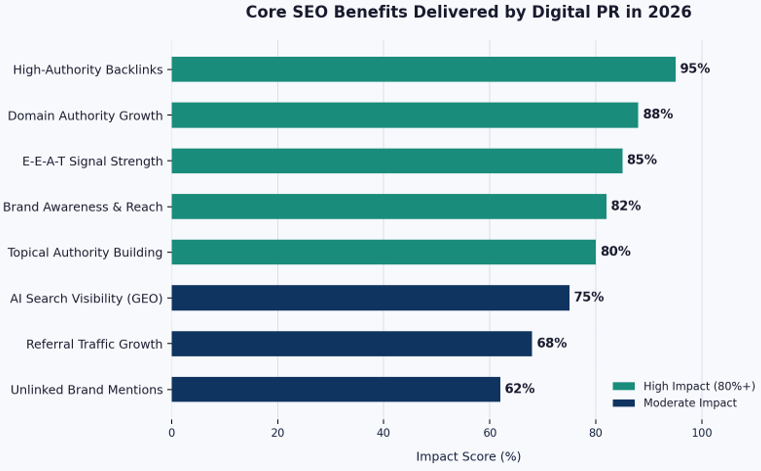
The core SEO benefits delivered by a well-executed Digital PR strategy (2026)
1. High-Authority Backlinks That Move Rankings
Backlinks remain one of the strongest ranking signals in Google‘s algorithm. A link from a high-authority news publication or a respected industry journal carries significantly more weight than a link from a low-traffic directory. Digital PR campaigns are designed specifically to earn links from the most authoritative domains in any given industry.
According to Reboot Online’s 2026 data, digital PR is now the most common link building tactic in the SEO industry, with one in six specialists citing it as their primary method and around one in five rating it as their single most successful strategy overall.
2. E-E-A-T: Expertise, Experience, Authoritativeness, and Trustworthiness
Google’s quality guidelines centre on E-E-A-T: Experience, Expertise, Authoritativeness, and Trustworthiness. These are not direct ranking factors you can optimise on-page, but they shape how Google’s algorithm evaluates your overall credibility as a source.
Digital PR is one of the most effective tools for building genuine E-E-A-T signals. When your executives are quoted as experts in industry publications, when your original research is cited by respected outlets, when multiple authoritative sites reference your brand in the context of your core topics, search engines build a picture of your organisation as a genuine authority. No amount of on-page optimisation alone can replicate that third-party validation.
3. Topical Authority Through Consistent Coverage
When a brand appears again and again in relevant media coverage tied to the same themes and areas of expertise, it builds what SEOs call topical authority. Search engines that see your brand consistently associated with a specific subject area across multiple authoritative sources grow more confident surfacing you for related queries. Digital PR builds that topical signal far faster than content production alone because the authority is validated externally, not just asserted internally.
Search Engine Land’s analysis of digital PR published in early 2026 describes this pattern as the mere exposure effect: familiarity builds trust, and repeated appearances in trusted sources shift both user perception and algorithmic credibility scores in your favour.
4. AI Search and Generative Engine Optimisation in 2026
Perhaps the most significant development shaping digital PR and SEO in 2026 is the growing influence of AI-powered search. ChatGPT, Perplexity, Google’s AI Overviews, and similar tools curate answers by drawing on content crawled from trusted sources. When someone asks an AI search tool about your industry, it delivers one authoritative answer. If your brand is not embedded in trusted, reputable media, it will not be part of that answer.
Linkflow’s 2026 analysis confirms that by the time a query is processed by an AI search system, most of the brand visibility outcome is already determined by how consistently and credibly the brand appears across authoritative sources. Digital PR is the primary mechanism for building that footprint before the query ever happens.
5. Unlinked Brand Mentions as Authority Signals
Search engines have evolved well beyond simply counting links. Unlinked brand mentions, instances where a publication references your brand or product without a hyperlink, also contribute to how Google understands your authority. This makes digital PR even more valuable than a raw link count would suggest. Every placement, linked or not, adds to the pattern of third-party validation that search algorithms use to evaluate credibility.
Digital PR Tactics That Drive the Strongest SEO Results
Not all digital PR tactics deliver equal SEO value. BuzzStream’s 2026 State of Digital PR Report provides a clear picture of what is working most effectively in practice.
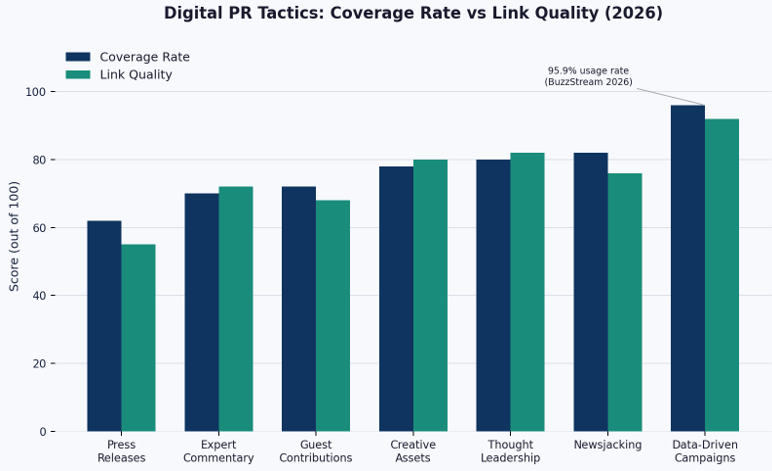
Digital PR tactics ranked by coverage rate and link quality performance (2026)
1. Data-Led Campaigns: The Dominant Tactic
Pitching data-led content is the most widely used digital PR tactic in 2026, employed by 95.9 percent of practitioners according to BuzzStream. Original data is the currency of digital PR because journalists need fresh, credible information to tell new stories. Brands that supply proprietary research, survey findings, or unique industry insights become go-to sources for coverage in their sector.
A data-driven campaign might involve surveying your customer base, analysing publicly available datasets, or publishing an original study on a trend in your industry. The findings become the backbone of a media pitch that offers journalists something they cannot find anywhere else. When the story runs, your brand is the authoritative source, and links naturally point back to wherever the full research lives on your site.
No Brainer Agency’s 2026 analysis makes a critical point here: strong headlines, clean charts, and a simple narrative explaining why the numbers matter will always outperform a dense report. The data needs to be credible and accurate, but the pitch needs to be effortlessly easy for a journalist to use on deadline.
2. Newsjacking and Reactive Expert Commentary
Newsjacking, inserting your brand into breaking news stories through timely expert commentary, consistently generates some of the highest-authority placements available. When a significant development happens in your industry, journalists look for credible voices to explain what it means. If your spokesperson is available, knowledgeable, and able to provide a clear point of view quickly, your brand becomes part of the story.
Motive PR’s 2026 digital PR statistics found that personalised, individual outreach significantly outperforms bulk approaches. Reactive commentary pitched quickly and personally to the right journalists converts at a higher rate than almost any other tactic, and the placements it earns tend to be in exactly the high-authority publications that move SEO metrics.
3. Thought Leadership and Guest Contributions
Placing long-form articles, opinion pieces, or expert guides on respected publications under the byline of a senior figure from your organisation builds a visible, credible presence in your industry’s media ecosystem. PRLab’s 2026 trends analysis highlights the growing importance of human-centred stories: research shows that consumers want brands to focus on original, experience-driven content rather than chasing trends. Journalists feel this too. Emotion-led, perspective-driven thought leadership consistently earns more shares, more citations, and more links than data-only content.
4. Press Releases in the Age of AI Search
Press releases are experiencing a clear resurgence in 2026. BuzzStream’s data shows their usage rising from 68.8 percent to 79.1 percent of digital PR practitioners in 2026. The driving factor is AI. Brands have recognised that press releases distributed on reputable platforms are indexed and cited by AI search systems as reference material. When your brand’s narrative is contained in a well-structured press release distributed to credible channels, it feeds directly into the ecosystem that AI tools draw from when generating answers.
5. Creative Asset Campaigns for Compounding Link Acquisition
Infographics, interactive tools, data visualisations, and creative research-led content attract links over an extended period long after initial launch. Publishers frequently embed visual content alongside editorial pieces, and when your infographic or interactive tool is the source material for a story, every site that republishes it links back to your domain. Asset-led digital PR campaigns tend to generate links on a long tail timeline, providing compounding SEO value that single-angle pitches cannot match.
How to Align Digital PR and SEO Strategy
The most powerful results come when digital PR and SEO are designed together from the start, sharing data, goals, and campaign briefs rather than operating as separate workstreams that occasionally intersect.
1. Let SEO Data Shape Your PR Angles
Keyword research tells you what your audience is actively searching for and where your brand’s authority gaps are. Digital PR should then build campaigns around those exact topics to earn authoritative coverage that directly reinforces your target rankings. If your SEO strategy identifies a high-value topic cluster your site is struggling to rank for, the answer may not be more content production. It might be a data-led PR campaign that earns editorial coverage from a dozen authoritative domains all pointing to your page on that subject.
Linkflow’s 2026 analysis puts it directly: a strong digital PR strategy does not start with a media list. It starts with search data. When PR angles are aligned with the language your SEO strategy targets, AI systems and search engines are far more likely to connect your brand with those concepts consistently.
2. Build Strong Landing Pages Before Campaigns Go Live
One of the most common and costly digital PR mistakes is running a campaign without a strong destination page. When a journalist covers your story and links to your site, the page they link to must be technically sound, clearly structured, and optimised for your target keywords. If links default to your homepage, a significant portion of the SEO value generated by the campaign is effectively lost.
Build dedicated landing pages for your PR campaigns before outreach begins, whether that is a research hub, a data visualisation page, or a thought leadership series. These pages accumulate link equity and pass authority through to the commercial pages you most want to rank for.
3. Use AI to Accelerate Without Losing Human Judgement
Cision’s Inside PR 2026 Report found that 92 percent of PR professionals now use generative AI tools in their work, primarily for brainstorming, content drafting, and research. BuzzStream found that 93 percent report AI speeds up their processes, and 82 percent believe it improves the quality of their output.
The nuance is critical, however. PRLab’s 2026 trends analysis notes that journalist fatigue with generic AI-generated pitches has reached serious levels. The teams consistently earning the best coverage in 2026 are using AI to accelerate research and insight gathering, then applying human judgement, creativity, and genuine expertise to shape the final campaign and outreach. AI is an accelerant for good PR strategy. It cannot replace the strategy itself.
4. Measure What Matters Across Both Channels
Integrated digital PR and SEO performance requires a unified measurement framework. The most useful metrics to track consistently include new referring domains earned from coverage, domain rating growth over time, keyword ranking improvements in the weeks following major placements, organic traffic growth to campaign landing pages, and branded search volume growth as coverage increases brand recognition. New Media’s 2026 analysis found that earned coverage often generates a ten to forty percent lift in branded search demand within seven to thirty days of a strong placement.
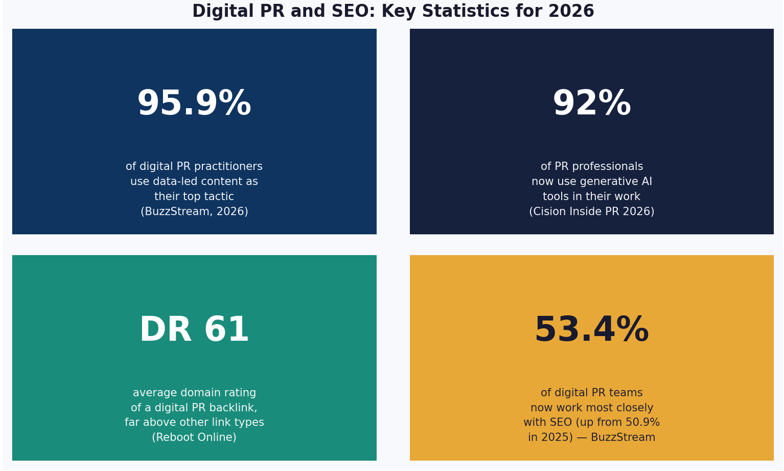
Key Digital PR and SEO statistics drawn from major 2026 industry reports
Common Mistakes That Undermine Digital PR and SEO Results
1. Running Campaigns Without a Genuine Editorial Angle
The most consistent reason digital PR campaigns fail to earn coverage is that they are built around what the brand wants to say rather than what the media wants to cover. Journalists are not interested in product announcements unless there is a genuine story behind them. Original data, a counterintuitive finding, or a timely connection to something already in the news are the angles that generate placements. Brands that treat digital PR as promotional messaging consistently struggle to earn coverage from the publications that would actually move their SEO metrics.
2. Treating Digital PR as a One-Off Activity
The compounding nature of digital PR rewards consistency over intensity. A single well-placed campaign might earn 15 to 20 links from authoritative domains. Twelve months of consistent activity can earn hundreds, and the cumulative authority impact of sustained investment is difficult to replicate with episodic campaigns. New Media’s 2026 data shows that programs running three to six months typically achieve a lower cost per result as journalist relationships develop and brand familiarity grows.
3. Neglecting Technical SEO Foundations
Digital PR earns the links, but if your site has crawlability issues, slow load times, or a weak internal linking structure, the authority those links generate will not translate into rankings as efficiently as it should. Strong technical SEO foundations are what allow digital PR investment to produce its full return. The two disciplines are interdependent: digital PR raises your authority ceiling, and technical SEO determines how close you get to it.
4. Ignoring Competitor Backlink Intelligence
Competitor backlink analysis is one of the most underused tools in digital PR campaign planning. If your main competitors have earned editorial links from a specific set of publications in your industry, those outlets have already demonstrated a willingness to cover stories in your space. That is a ready-made media target list, and it tells you exactly where to focus outreach efforts first, saving significant prospecting time and increasing campaign efficiency from the start.
A Practical Framework for Your First Integrated Campaign
Whether you are running this in-house or working with a digital PR agency, this seven-step framework provides a repeatable starting point for campaigns that produce both media coverage and measurable SEO results.
- Define the SEO objective first: Identify the specific keywords or topic clusters you want to strengthen, and where authoritative external coverage would have the greatest impact on your rankings.
- Identify your data asset: What original research, proprietary insight, or unique perspective does your organisation have that no competitor can replicate? That becomes your campaign foundation.
- Build and optimise the destination page: Create or prepare the on-site page where PR links should point. Optimise it for target keywords and ensure it is technically sound before any outreach begins.
- Map the media landscape using backlink data: Use tools like Ahrefs or Semrush to identify where competitors earn their strongest links. Build a target publication list based on demonstrated editorial interest in your space.
- Craft a pitch around editorial value: Write a pitch focused entirely on the story value for the journalist’s audience. Include your data, a clear headline angle, and any visual assets that make the story easier for them to publish. Motive PR’s 2026 data found pitches with questions in the subject line had a 13 percent lower open rate, so keep subject lines declarative and specific.
- Execute through personalised one-to-one outreach: BuzzStream’s 2026 report confirms that individual personalised outreach consistently outperforms bulk approaches. Make every pitch feel like it was written specifically for that journalist.
- Track, measure, and compound: Monitor new referring domains weekly. Measure keyword ranking changes in the four to six weeks following major placements. Use coverage data to inform the topic angles for your next campaign.
Conclusion: In 2026, Digital PR Is One of the Core SEO Strategy
If SEO is how people find you, digital PR is why they trust you. And in 2026, search engines are no longer just ranking pages. They are evaluating brands, looking at who mentions them, where they are referenced, and whether authoritative third parties vouch for their expertise. At the same time, AI systems like ChatGPT and Perplexity source their answers from the same trusted media ecosystem that digital PR is built to influence.
The brands pulling ahead in organic search in 2026 are not the ones publishing more content or spending more on technical optimisation alone. They are the ones building genuine authority through earned media, expert positioning, and the consistent pattern of third-party validation that both search engines and AI tools are specifically designed to surface and reward.
BuzzStream’s 2026 State of Digital PR Report makes the direction of travel clear: digital PR has moved from tactic to core strategic pillar. Brands investing in it consistently are seeing measurable gains in domain authority, keyword rankings, and AI search visibility. The question for any marketing team in 2026 is not whether digital PR and SEO should work together. The question is how quickly you can build a system where they do.
Key Takeaways
- Digital PR builds brand authority and online visibility through earned media coverage, high-quality backlinks, and brand mentions on trusted digital channels. In 2026, it is inseparable from a serious SEO strategy.
- Digital PR directly improves SEO by earning high-authority backlinks averaging DR 61 per placement, strengthening E-E-A-T signals, building topical authority, and generating brand mentions that search engines use to assess credibility.
- AI search makes digital PR more important in 2026, not less. Consistent earned media presence across authoritative sources is one of the primary factors determining whether your brand appears in AI-generated answers from tools like ChatGPT, Perplexity, and Google’s AI Overviews.
- Data-led campaigns are the dominant digital PR tactic in 2026, used by 95.9 percent of practitioners (BuzzStream). Original, ownable data combined with a clean editorial narrative is the most reliable path to high-authority coverage.
- 92 percent of PR professionals now use generative AI tools in their work (Cision Inside PR 2026), but the teams earning the best coverage use AI for acceleration, not as a replacement for human strategy and genuine expertise.
- Integrated digital PR and SEO programs running consistently over three to six months deliver lower cost per result and build compounding authority that episodic campaigns cannot replicate.
Frequently Asked Questions
Topical FAQ
LinkPanda Service FAQ
Sources
External Sources
Ahrefs Digital PR for SEO: How to Build High-Authority Links
Ahrefs’ definitive digital PR and SEO guide — the practice of creating newsworthy content and earning editorial links from major publications as the primary intersection between PR and search.
Backlinko Link Building Strategies That Work
Backlinko’s strategy guide establishing digital PR as the most reliable method for earning links from publications with DR 70–90+ that are completely inaccessible through standard outreach.
Content Marketing Institute Original Research: The Content Type That Earns the Most Links
CMI’s research confirming original data studies as the most reliably effective digital PR asset — content that forces editorial citation because no alternative source for the specific finding exists.
Ahrefs How to Create Original Research That Earns Links
Ahrefs’ original research guide — the methodology for designing and conducting the surveys and data analyses that give journalists a citable, newsworthy finding to build coverage around.
Google Search Central A Guide to Google Search Ranking Systems
Google’s ranking systems documentation — confirming that fully editorial links from independent publisher decisions represent the signal links are designed to measure, and why digital PR produces the highest-quality links available.
Internal References

LinkPanda Digital PR: How to Earn Editorial Links Through Media Coverage
The full digital PR methodology from data asset conception through journalist distribution to link confirmation — the practical execution of the complete digital PR and SEO strategy.
LinkPanda Authority Links: How to Earn Links From High-Authority Sites
Why digital PR is the primary route to the DR 70–90 authority links that produce the most significant ranking improvements — and how to build campaigns that consistently earn them.
LinkPanda Media Pitch Examples: How to Write Pitches Journalists Respond To
The pitch craft that converts digital PR data assets into published coverage — how to frame a newsworthy finding so editors immediately recognise its value to their audience.
LinkPanda Link Bait: Create Content That Earns Links
How the link bait content strategy feeds into digital PR campaigns — the original research and data assets that serve both as editorial link earners and as newsworthy PR hooks.
About The Author

Irfan Rashid
Irfan Rashid is an experienced Search Engine Optimization (SEO) specialist with expertise in website management and content optimization. As a Website Blog Administrator and SEO Specialist, he manages blog operations, optimizes content for search engines, and improves website performance through data-driven SEO strategies. Skilled in WordPress, technical SEO, and content optimization, he focuses on increasing organic visibility and maintaining strong search performance.