How to Build a Backlink Profile That Stands Up to Algorithm Changes and Penalties
Imagine investing months of effort into an SEO strategy, only to watch it collapse overnight because the tactics underpinning it crossed a line. It happens more often than most people admit, and Google’s continued investment in spam detection makes it an increasingly likely outcome for anyone cutting corners.
Google’s SpamBrain system now detects 50 times more link spam sites than it previously could, and its ability to identify hacked spam has improved tenfold. The margin for error with manipulative link building has never been thinner. White hat link building is not just the ethical choice; at this point, it is the only approach with a realistic path to sustainable rankings.
This guide covers what white hat link building actually means, why it matters now more than ever, and the strategies that consistently deliver authority without the risk.
What Is White Hat Link Building?
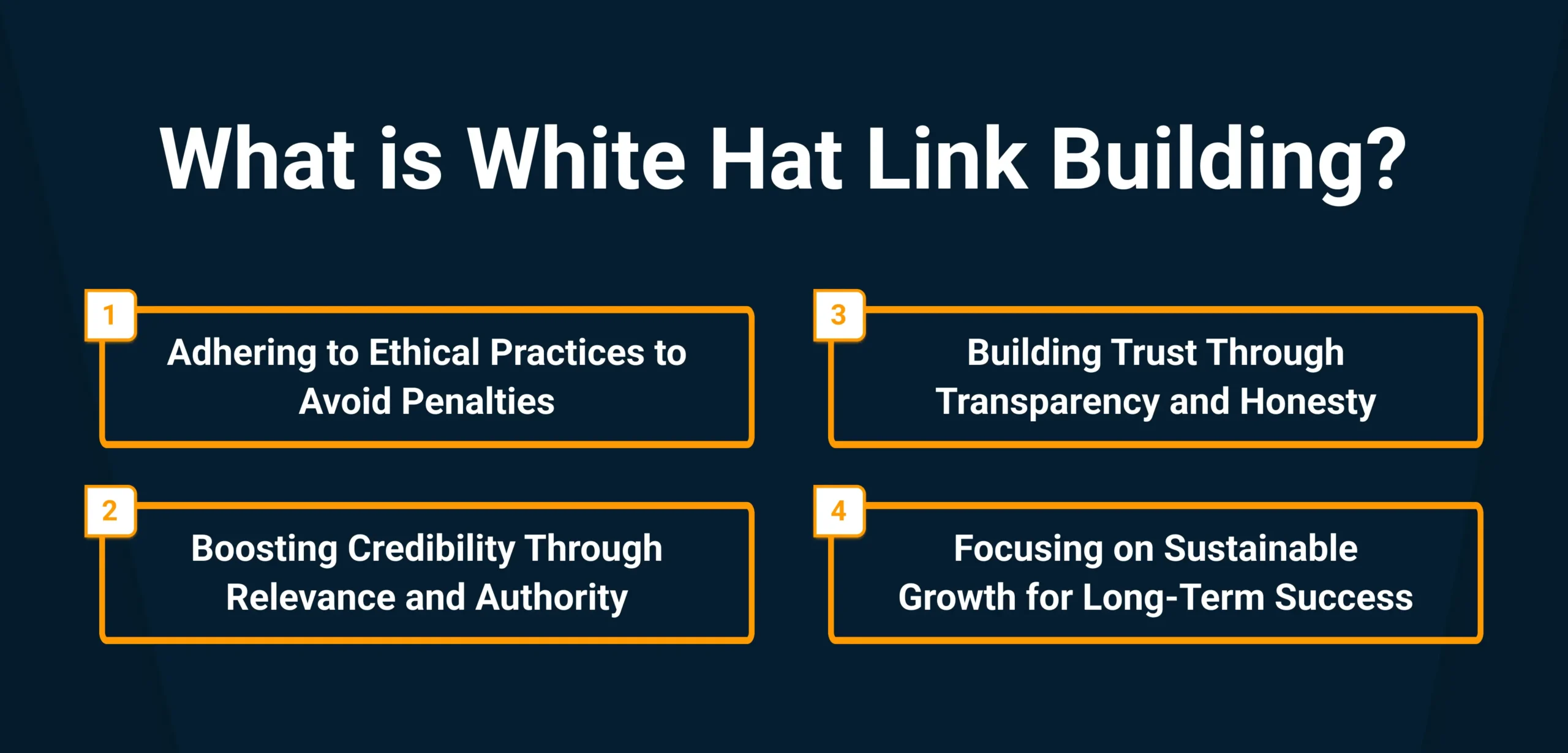
White hat link building is the process of acquiring backlinks through methods that comply fully with search engine guidelines. Every link is earned through genuine value, transparent outreach, and legitimate relationships rather than through manipulation, deception, or paid schemes.
The approach is built on four foundations:
Ethical practices. Every tactic used respects search engine rules. No deceptive redirects, no link farms, no paid placements disguised as editorial links.
Relevance and authority. Links are sought from reputable, contextually relevant websites that genuinely strengthen your backlink profile rather than just adding numbers to it.
Transparency. Outreach is honest about intent. Webmasters and site owners know what they are agreeing to, which builds real relationships rather than transactional ones.
Long-term focus. The goal is a backlink profile that compounds in value over time, not one that produces a short burst of rankings before attracting a penalty.
White Hat vs. Grey Hat vs. Black Hat: A Quick Reference
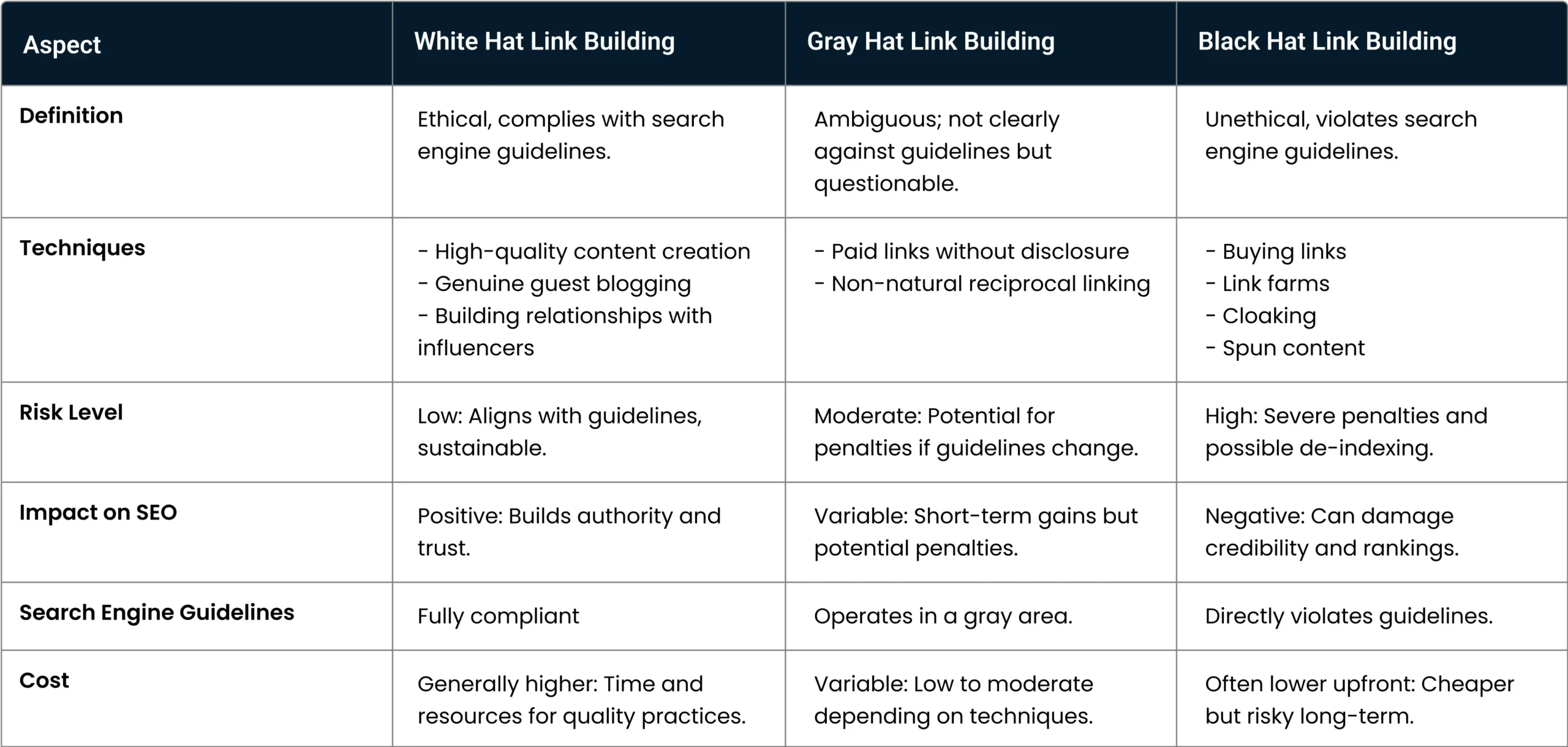
Not all link building carries the same risk or produces the same outcomes. Understanding where each approach sits on the spectrum is essential for making informed decisions about your strategy.
| White Hat | Grey Hat | Black Hat | |
|---|---|---|---|
| Compliance | Fully within guidelines | Bends the rules | Violates guidelines |
| Risk | Minimal | Moderate | High |
| Results timeline | Slower but stable | Faster but uncertain | Fast but unsustainable |
| Penalty exposure | Very low | Possible if overused | Likely |
| Long-term value | High | Variable | Low |
| White Hat | Grey Hat | Black Hat |
|---|---|---|
| Fully within guidelines | Bends the rules | Violates guidelines |
| Minimal Risk | Moderate Risk | High Risk |
| Slower but stable | Faster but uncertain | Fast but unsustainable |
| Very low penalty exposure | Possible penalty if overused | High penalty Exposure |
| High Long-Term-Value | Variable Long-Term-Value | Low Long-Term-Value |
The pattern here is consistent: as you move from white to grey to black hat, upfront cost and effort decrease while long-term risk increases dramatically. White hat link building costs more in time and resources precisely because it is producing something durable. Black hat tactics are cheaper because they are shortcuts that come with an expiry date.
Grey hat sits in a genuinely uncomfortable middle ground. The techniques are not outright prohibited, but they depend on search engines failing to detect them. As Google’s spam detection capabilities continue to improve, the window of tolerance for grey hat practices narrows. What goes undetected today may not tomorrow.
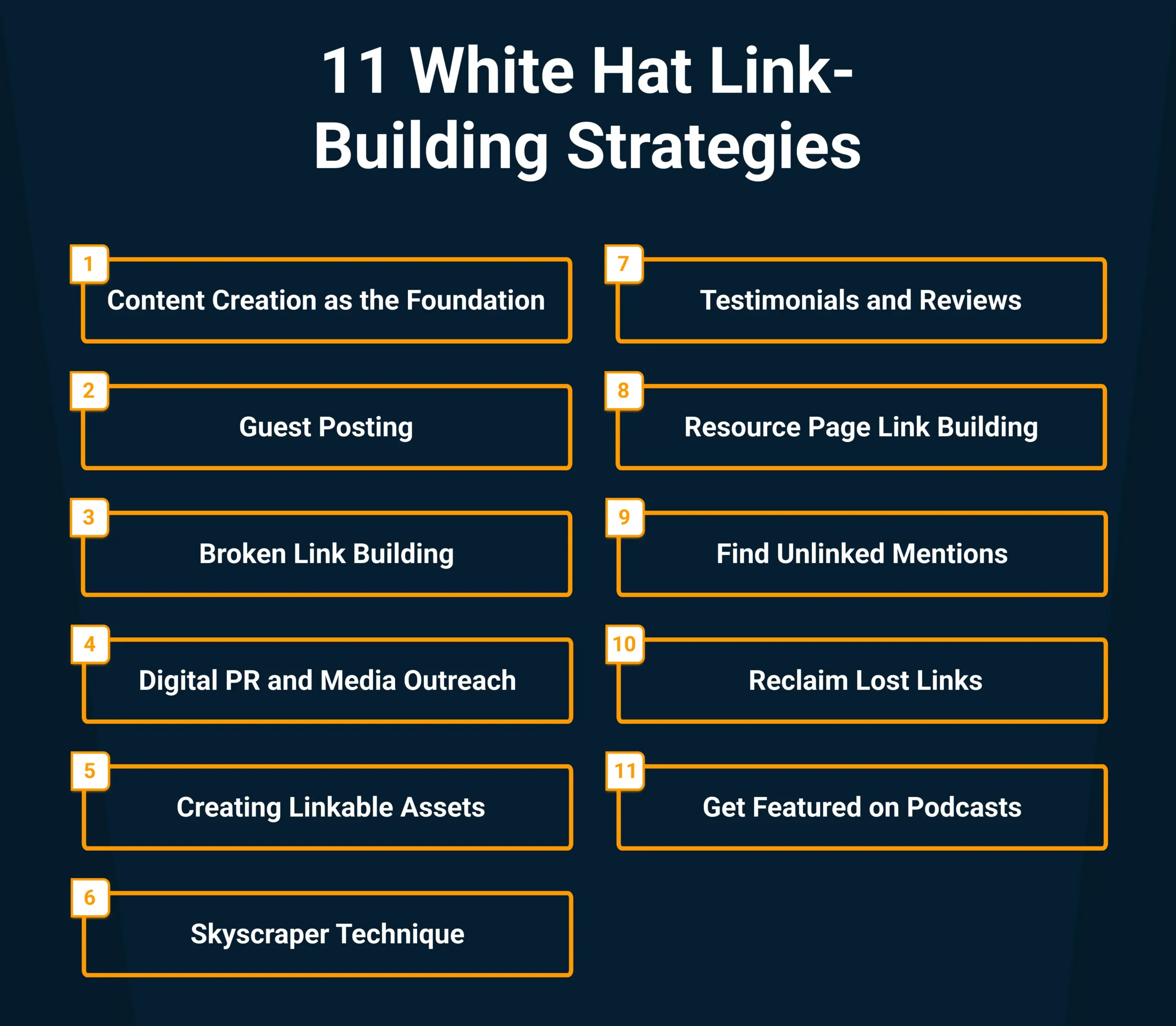
11 White Hat Link Building Strategies That Build Real Authority
1. Content Creation as the Foundation
The most durable white hat link building strategy is also the most straightforward: create content that other sites genuinely want to reference. This means going beyond surface-level blog posts and producing resources with real depth, original data, or unique perspective.
Google’s E-E-A-T framework (Experience, Expertise, Authoritativeness, Trustworthiness) is worth keeping front of mind here. Content that embodies these principles not only attracts more backlinks but earns higher rankings independently, creating a compounding effect where better visibility leads to more links and more links lead to better visibility.
2. Guest Posting
Contributing high-quality content to reputable sites in your niche earns backlinks through permission and collaboration rather than manipulation. The key distinction from grey hat guest posting is the intent: white hat guest posting prioritizes value for the host site’s audience first, with the backlink as a byproduct of that value rather than the sole objective.
When executed well, guest posting builds domain authority, expands brand reach, and creates genuine industry relationships that often produce further link opportunities down the line.
3. Broken Link Building
Identify broken links on authoritative sites in your niche using tools like Ahrefs or Screaming Frog, then reach out to the site owner with a relevant replacement from your own content. You are solving a real problem for them while earning a contextually appropriate backlink in return.
This method is well-regarded precisely because it is genuinely collaborative. The value exchange is clear and immediate, which makes it one of the more effective outreach strategies in terms of response rate.
4. Digital PR and Media Outreach
Creating and distributing compelling press releases, pitching journalists, and contributing expert insights through platforms like Connectively positions your brand as a credible industry voice while earning backlinks from high-authority media sources.
The content driving this outreach should be genuinely newsworthy: original research, significant product or company milestones, expert commentary on major industry developments, or data that gives journalists something new to report on. Thinly veiled promotional content rarely earns coverage from serious publications.
5. Creating Linkable Assets
Certain content formats earn links consistently because they provide value that text alone cannot. Infographics translate complex data into a shareable visual format that other sites want to embed and reference. Interactive tools and calculators deliver personalized outputs that add direct utility for readers, giving other sites a strong reason to link rather than reproduce the functionality themselves.
These assets require upfront investment but tend to earn links passively over time, making them one of the highest-ROI formats in a white hat strategy.
6. The Skyscraper Technique
Find the best-performing content in your niche that has already attracted significant backlinks, then produce a version that is demonstrably more comprehensive, more accurate, or more current. Once published, reach out to sites linking to the original and present your version as the stronger resource.
The outreach needs to be specific and evidence-based. Explain precisely what your version adds that the original does not, and make the case for why their audience would be better served by linking to yours.
7. Testimonials and Reviews
Providing genuine testimonials for products or services you have used is a straightforward way to earn backlinks. Companies regularly feature testimonials on their websites with a link back to the contributor’s site, and in-depth, well-researched reviews of industry tools can earn citations from the companies reviewed or from other sites referencing your analysis.
The links earned this way are typically natural and highly contextual, both positive signals to search engines.
8. Resource Page Link Building
Resource pages are curated lists of valuable references maintained by industry blogs, educational institutions, and authority sites. Getting your content listed on a relevant resource page earns a high-quality, editorially placed backlink with strong topical relevance.
The approach requires two things: identifying resource pages that are a genuine fit for your content using search operators and SEO tools, and ensuring your content is actually worth including. Pitching weak or generic content to resource page curators rarely succeeds.
9. Unlinked Brand Mentions
Every time your brand, product, or content is mentioned online without a corresponding backlink, that is an opportunity waiting to be converted. Use tools like Google Alerts, Ahrefs, or Mention to track these references, then contact the author or webmaster and politely ask them to add a link.
Conversion rates on these requests tend to be high. The person has already demonstrated they value your brand enough to reference it; adding a link is a small ask that most are willing to fulfil.
10. Link Reclamation
Links that once pointed to your site but now lead to broken or redirected pages represent lost link equity that can often be recovered. Use Ahrefs, Moz, or Google Search Console to identify these lost links, then either fix the broken page, set up a proper redirect, or contact the linking site with an updated URL.
Reclamation is one of the most efficient white hat tactics available because the hard work of earning the link has already been done. You are simply restoring value that already exists.
11. Podcast Appearances
Appearing as a guest on relevant industry podcasts builds authority and earns backlinks from show notes on established platforms. Identify podcasts in your niche with an engaged audience, pitch the host with a clear angle that demonstrates the value you bring to their listeners, and use the appearance to share genuinely useful insights rather than promotional talking points.
Joe Rogan’s podcast, as a reference point for what link equity looks like at scale, has earned over 148,000 backlinks organically. The authority that comes from consistent podcast appearances compounds in a similar way, just proportionate to the scale of the shows you appear on.
Tools for White Hat Link Building
Ahrefs is the primary tool for backlink analysis, competitor research, broken link identification, and tracking referring domain growth. Most serious link building workflows are built around it.
Moz provides spam score and domain authority data useful for qualifying link targets before investing outreach effort.
SEMrush complements both with keyword tracking, traffic analysis, and backlink auditing for a fuller picture of your link profile health.
Regular auditing using these tools keeps your profile clean. If low-quality or spammy links appear, Google’s Disavow Tool allows you to instruct search engines to ignore them before they affect your rankings.
Frequently Asked Questions
How does white hat link building hold up when Google updates its algorithm? Because white hat links are earned through genuine editorial value, they are largely insulated from algorithmic shifts. Google’s updates are designed to reward legitimate authority and penalize manipulation. A backlink profile built on real relevance and credibility becomes more valuable over time as updates raise the bar for what counts as a quality link.
What is the realistic timeline for results from white hat link building? Most sites see meaningful ranking movement within three to six months of a consistent white hat campaign, with significant authority gains developing over twelve to eighteen months. The compounding nature of link equity means results accelerate as the profile grows, but early patience is essential. Sites targeting highly competitive keywords should plan for the longer end of that range.
How do I prioritize which white hat strategies to focus on first? Start with the tactics that offer the best return relative to your current resources. Unlinked mention reclamation and broken link building require time rather than content production and often yield quick wins. Guest posting and digital PR take more effort but produce higher-authority placements. Linkable asset creation requires upfront investment but earns links passively over time. A balanced mix of quick-return and long-term strategies is more effective than going all-in on a single approach.
Can white hat link building compete with competitors using grey or black hat tactics? Yes, and increasingly so. As Google’s spam detection improves, grey and black hat profiles face growing penalty risk. A white hat profile that is three years old is also significantly harder to displace than one built on manipulative links, because the authority is genuine and the links are stable. Short-term gaps in rankings often close as competitor profiles accumulate algorithmic risk.
What makes a backlink “high quality” in the context of white hat link building? Relevance, authority, and editorial context. A high-quality backlink comes from a domain with strong DR and organic traffic, appears within content that is topically relevant to your site, is placed in a natural editorial context rather than a sidebar or footer, and uses anchor text that reads naturally rather than being keyword-stuffed. Links that check all of these boxes move the needle; links that check none of them are largely neutral at best.
How important is anchor text diversity in a white hat link profile? Very important. A natural link profile contains a mix of branded anchors, naked URLs, generic phrases like “read more,” and some keyword-relevant anchors. Over-optimizing toward exact-match keyword anchors, even through legitimate outreach, can trigger algorithmic flags because it looks like the link profile is being engineered rather than earned organically.
Is it worth disavowing low-quality links if I did not build them? Sometimes. Negative SEO, where competitors point toxic links at your site, does occur. If you notice a sudden influx of low-quality referring domains or a spike in your spam score, investigate immediately. Use Google’s Disavow Tool for links that are clearly harmful and that you cannot get removed through direct outreach. For borderline cases, Google is generally good at ignoring low-quality links without disavowal, but when in doubt, disavowing is the lower-risk option.
How do I measure the ROI of a white hat link building campaign? Track referring domain growth, DR trajectory, organic traffic, and target keyword rankings over time in parallel. A single new backlink rarely produces a visible ranking change in isolation, so measurement needs to be aggregate and longitudinal. Cross-reference backlink acquisition dates with ranking movements in Google Search Console to identify which link placements are driving the most meaningful results, and use that data to prioritize similar opportunities going forward.
Final Thoughts
White hat link building is the only approach to backlink acquisition that produces results you can rely on as search engines become more sophisticated at detecting manipulation. The sites that consistently rank well in competitive niches are not the ones that found the cleverest shortcuts; they are the ones that invested steadily in building genuine authority.
Every quality backlink earned through ethical means is a durable asset. Every manipulative link is a liability waiting to be discovered. The gap between those two outcomes is what white hat link building is designed to protect.
At LinkPanda, we build white hat link building campaigns tailored to your specific goals, from guest posting and digital PR to broken link building and outreach. Every link we earn is built to last. Get in touch to find out how we can help you build a backlink profile that stands up over the long term.
Frequently Asked Questions
Topical FAQ
LinkPanda Service FAQ
About The Author

Christopher Lier
Christopher is an experienced Search Engine Optimization (SEO) marketer and digital marketing specialist. He is Co-Founder of LinkPanda and leads the marketing and sales teams. Mostly known as a Software-as-a-Service co-founder of LeadGen App, he has helped grow the website to become a renowned player in the lead generation space with steadily growing user base and readership.
You May Also Like
Link Reclamation: How to Find and Recover Lost Backlinks

23 Best Tech Startups in Finland: The Nordic’s Startup Hall of Fame

Best Enterprise SEO Agency Picks for 2026

Best AI SEO Tools for 2026 (Reviewed and Compared)
Best Link Building Tools for 2026 (Reviewed and Compared)

Top SEO Companies & Agencies in the USA
The 15 Best SEO Agencies in the UK (2026)
Backlinks vs. Referring Domains: The Metric That Actually Predicts Rankings
How to Build a Global SEO Strategy That Actually Scales
Getting Cited by ChatGPT and Perplexity: A Practical SEO Playbook
How AI Overviews Are Rewriting the Rules of Link Building in 2026

Link Building for Fintech: The Sub-Vertical Playbook (2026)