The Sustainable Way to Build SEO Authority Without the Risk
Sustainable growth in search rankings is one of the hardest things to achieve in SEO, especially when shortcuts like buying links, using PBNs, or other manipulative tactics are constantly dangled as faster alternatives. The problem is those shortcuts tend to deliver short-term gains at the expense of long-term stability.
Organic link building offers a better path. By producing genuinely valuable content and building real relationships with other players in your industry, you can earn authoritative backlinks naturally, improving your SEO results, strengthening your brand reputation, and building audience trust that compounds over time.
This guide covers what organic link building is, why it works, and the practical techniques you can start using today.
What Is Organic Link Building?

Organic link building is the process of earning backlinks naturally, without explicitly asking for them or using incentives to obtain them. Other site owners link to your content because they find it genuinely useful and believe their audience will too.
This approach is grounded in quality and ethics. Rather than manufacturing links through schemes or outreach campaigns designed purely to extract backlinks, organic link building focuses on creating real value: through content, expertise, and industry relationships. The result is a backlink profile that grows steadily, holds up against algorithm changes, and reflects actual credibility rather than manufactured authority.
Benefits of Organic Link Building

Sustainability and stability. Organic links are earned through content relevance and genuine user interest. They tend to stick around and are far less vulnerable to algorithmic updates or manual penalties than links acquired through manipulative tactics.
Compliance with SEO guidelines. Because organic link building follows ethical practices by definition, it keeps your backlink profile clean and reputable, minimizing the risk of search engine penalties.
Enhanced authority and credibility. Links from relevant, authoritative sources improve your domain authority and reinforce your site’s reputation as a trusted resource, both to search engines and to real users.
Cost efficiency. Organic link building reduces dependence on paid strategies. While it requires an investment of time and effort, it delivers sustainable growth through content and genuine value rather than recurring ad spend.
User-centric engagement. When web admins link to your site of their own accord, it signals that your content genuinely benefits their audience. That kind of engagement improves user experience and builds lasting loyalty.
Adaptability to algorithm changes. Because organic links are earned naturally, they remain relevant and effective even as search engine algorithms evolve. What’s genuinely useful today will still be genuinely useful after the next Google update.
Practical Techniques for Building Organic Links
Create Link-Worthy Content
The most reliable way to earn organic backlinks is to create content that other sites genuinely want to reference. That means going beyond surface-level blog posts and producing resources with real depth and utility.
Formats that consistently attract organic links include original research and data from surveys or studies, comprehensive long-form guides with practical examples, visual assets like high-quality infographics and explainer videos, and how-to content that solves specific, well-defined problems.
A strong example of this in practice is WordStream’s Google Ads benchmark report, which has accumulated over 8,000 do-follow backlinks. It earned those links not through outreach campaigns alone, but because it became the go-to reference for its topic. That’s the compounding power of genuinely link-worthy content.
Convert No-Follow Links to Do-Follow

No-follow links naturally accumulate through blog comments, forum posts, social media, and press releases. While they do not directly pass SEO value, they drive traffic, build brand recognition, and signal to search engines that your content is worth promoting.
One underutilized tactic is converting high-value no-follow links to do-follow. By regularly auditing your backlink profile using tools like Ahrefs or SEMrush, you can identify high-authority domains that are linking to you with no-follow attributes. From there, you can reach out to those webmasters and request that they switch the link to do-follow.
To put the scale of this opportunity in perspective: WordStream has over 1,000 no-follow backlinks from domains with ratings between DR 60 and 90. That’s a significant pool of high-authority links that could be converted into direct SEO value with the right outreach.
Leverage Connectively (Formerly HARO)

Connectively, previously known as Help a Reporter Out (HARO), connects journalists and writers with expert sources. By responding to relevant queries with concise, well-informed answers, you position yourself as a credible voice in your industry and earn mentions and backlinks from reputable publications in return.
The key to success here is focus and quality. Responding to every query is less effective than identifying the ones where you can offer genuine expertise and crafting responses that are specific, useful, and easy for journalists to work with. Done consistently, this strategy builds both organic backlinks and long-term industry authority.
Use Help a B2B Writer
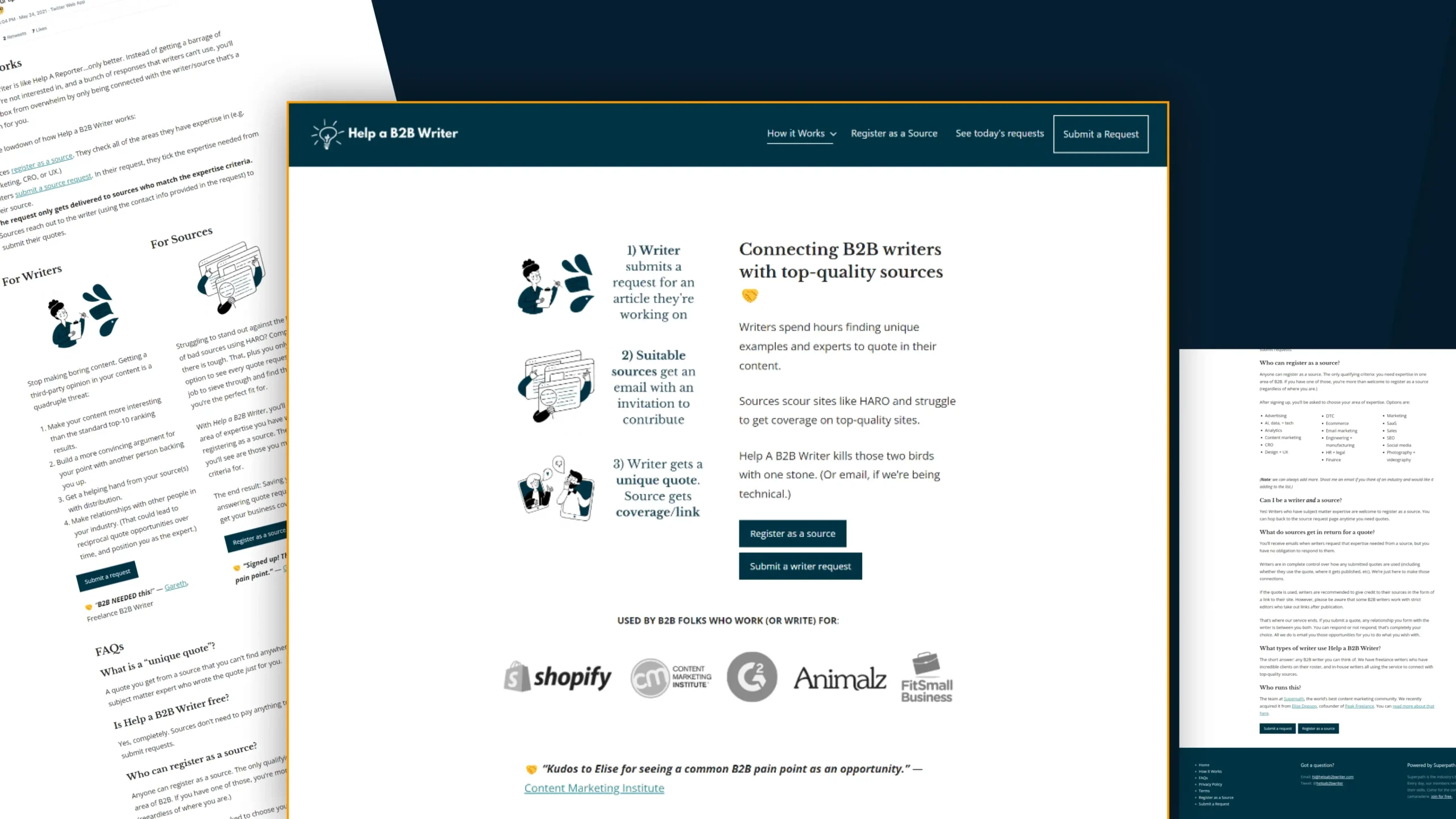
Help a B2B Writer is a platform designed to connect B2B content creators with qualified expert sources. Writers use it to find credible quotes and unique insights for their articles; sources use it to gain targeted exposure and earn organic backlinks aligned with their area of expertise.
For businesses, it offers a low-friction way to earn backlinks from B2B publications without the overhead of traditional outreach. You register as a source, respond to relevant requests on your own terms, and let the platform do the matching. The backlinks you earn come embedded naturally in high-quality content, which makes them more valuable both to search engines and to readers.
Frequently Asked Questions
How does organic link building differ from traditional link building outreach? Traditional outreach is proactive: you identify targets, pitch, and negotiate placements. Organic link building is reactive in the best sense: your content is strong enough that other sites link to it without being asked. In practice, most effective strategies combine both. You can create genuinely link-worthy content and still use outreach to accelerate its reach, as long as the links you earn reflect real editorial value rather than a transaction.
What types of content consistently earn the most organic backlinks? Original data and research consistently outperform other formats because they give other publishers something unique to cite. Beyond that, comprehensive reference guides, well-designed infographics, and tools or calculators tend to accumulate links over time because they remain useful long after publication. Thin content and generic listicles rarely earn organic links regardless of how well they are promoted.
How long does it take to see results from organic link building? Realistically, three to six months before meaningful movement in rankings, and longer before a sustained organic backlink profile develops. The compounding nature of organic links means results accelerate over time, but early-stage patience is non-negotiable. Sites in competitive niches with low existing domain authority should plan for a longer runway.
How do I know if a backlink was earned organically or acquired manipulatively? Context is the clearest signal. Organic links tend to appear within relevant editorial content, reference specific pages or data points on your site, and come from domains that have no prior relationship with you. Acquired links often cluster around the same anchor text, come from domains with thin or irrelevant content, or appear in bulk within a short timeframe. Tools like Ahrefs and SEMrush can help surface anomalous patterns in your backlink profile.
What is the relationship between organic link building and topical authority? Topical authority and organic link building reinforce each other directly. Sites that consistently publish deep, accurate content on a specific subject attract more links from within that subject area, which signals to search engines that the site is a credible hub for that topic. Over time, this creates a compounding advantage: stronger topical authority leads to more organic links, which further strengthens topical authority.
Can no-follow links contribute to an organic link building strategy? Yes, though indirectly. No-follow links from high-traffic sources drive referral visitors, increase brand exposure, and can lead to do-follow links from other publishers who discover your content through those mentions. They also contribute to a natural-looking link profile, since a backlink portfolio made up entirely of do-follow links can appear suspicious to search engines.
How should I track the SEO impact of organic backlinks? Monitor referring domain growth, domain rating trajectory, and organic traffic trends in parallel. A single new backlink rarely moves the needle in isolation, so tracking at the aggregate level over time gives a more accurate picture. Cross-reference backlink acquisition dates with ranking changes for target keywords in Google Search Console to identify which links are driving meaningful movement.
What are the most common mistakes that prevent sites from earning organic backlinks? Publishing content that closely mirrors what already exists rather than adding new data, perspective, or depth. Targeting topics too broad to rank for or too narrow to attract linking interest. Neglecting internal linking, which limits how effectively link equity flows through the site. And underinvesting in content promotion, since even exceptional content rarely earns links if the right people never see it.
Final Thoughts
Organic link building is the foundation of any SEO strategy built to last. It takes longer than shortcuts, but the links you earn are more durable, more credible, and far less likely to become a liability when search engine algorithms shift.
The path forward is straightforward: create content worth linking to, convert the no-follow links you have already earned, and use platforms like Connectively and Help a B2B Writer to earn expert mentions from authoritative sources.
At LinkPanda, we specialize in link building strategies tailored to your specific goals, from link insertions and PR links to comprehensive outreach campaigns. If you are ready to build a backlink profile that actually holds up, get in touch and let’s put a plan together.
Frequently Asked Questions
Topical FAQ
LinkPanda Service FAQ
About The Author

Christopher Lier
Christopher is an experienced Search Engine Optimization (SEO) marketer and digital marketing specialist. He is Co-Founder of LinkPanda and leads the marketing and sales teams. Mostly known as a Software-as-a-Service co-founder of LeadGen App, he has helped grow the website to become a renowned player in the lead generation space with steadily growing user base and readership.
You May Also Like
Link Reclamation: How to Find and Recover Lost Backlinks

23 Best Tech Startups in Finland: The Nordic’s Startup Hall of Fame
Best Enterprise SEO Agency Picks for 2026
Best Link Building Tools for 2026 (Reviewed and Compared)
Top SEO Companies & Agencies in the USA
The 15 Best SEO Agencies in the UK (2026)
Backlinks vs. Referring Domains: The Metric That Actually Predicts Rankings
How to Build a Global SEO Strategy That Actually Scales

Getting Cited by ChatGPT and Perplexity: A Practical SEO Playbook
How AI Overviews Are Rewriting the Rules of Link Building in 2026

Link Building for Fintech: The Sub-Vertical Playbook (2026)
Link Building in 2026: 34 Stats From Real Data