Listicle backlinks are links to your website from list articles on other sites, such as “Best Project Management Tools” or “Top SEO Agencies in the USA”. You get one when a publisher includes your brand as an entry in their list and links to you from it.
They have quickly become one of the most talked about link types in SEO. The reason is simple: The same lists that buyers use to build a shortlist are now the pages AI tools read most when they recommend a product or service.
This guide explains what makes listicle backlinks different from other links, what they do for rankings and AI search, what the latest research says, and how to tell a strong placement from a weak one.
Key Point: A listicle backlink is worth more than its link value alone. It puts your brand on a buyer’s shortlist, next to the competitors they are already comparing, on a page AI tools are likely to read.
What Are Listicle Backlinks?
A listicle backlink is a link placed inside an entry on a list style article. A typical entry has your brand name as a heading, a short description of what you do and who you are for, sometimes a screenshot or pricing note, and a link to your site.
The link usually points to your homepage or a main product page, and the anchor text is usually your brand name. That makes listicle backlinks among the most natural looking links you can earn, because a list entry linking to the brand it describes is exactly what readers expect.
Listicle backlinks come in a few forms:
- Earned placements, where a writer adds you after outreach or because they already use your product.
- Updated placements, where you are added to an existing list when the publisher refreshes it.
- Placements on new lists, where a publisher writes a fresh list and includes you from the start.
- Sponsored or paid listings, which some sites offer openly and label as such.

How Listicle Backlinks Differ From Other Backlinks
Every backlink passes some authority. What makes listicle backlinks different is the context around the link.
| Link type | Where the link sits | Typical anchor | Main benefit |
|---|---|---|---|
| Listicle backlink | Your own entry on a “best X” list | Brand name | Shortlist visibility, buyer traffic, AI citations |
| Niche edit | Inside an existing article’s text | Partial match or branded | Relevant link on an aged, indexed page |
| Guest post | Inside a new article you supply | Partial match or branded | Topical link plus content on a relevant site |
| Digital PR | News or feature coverage | Brand name or none | High authority links and brand reach |
| Brand mention | Text mention, sometimes unlinked | None or brand | Entity and brand signals |
A guest post or niche edit is usually about supporting a topic or keyword. A listicle backlink is about being chosen. The page tells the reader, and any AI tool reading it, that your brand is one of the options worth considering in your category.
That is why listicle backlinks work well alongside other link types rather than replacing them. We explain how the main link types compare in our guide to editorial links.
Why Listicle Backlinks Matter More in 2026
AI Tools Cite Listicles More Than Any Other Format
Several large studies published in 2026 point the same way. Wix analysed 75,000 AI answers with over 1 million citations across ChatGPT, Google AI Mode and Perplexity, and found listicles were the most cited website format at 21.9 percent of citations.1 For commercial intent questions, the share going to listicles rose to 40 percent, nearly double any other type.2
Ahrefs found something similar when it studied 750 prompts and 26,283 source URLs: “Best X” blog lists made up 43.8 percent of all page types ChatGPT cited.3 And an Evertune review of the most cited URLs across six AI models found listicles made up 40 to 65 percent of them.4
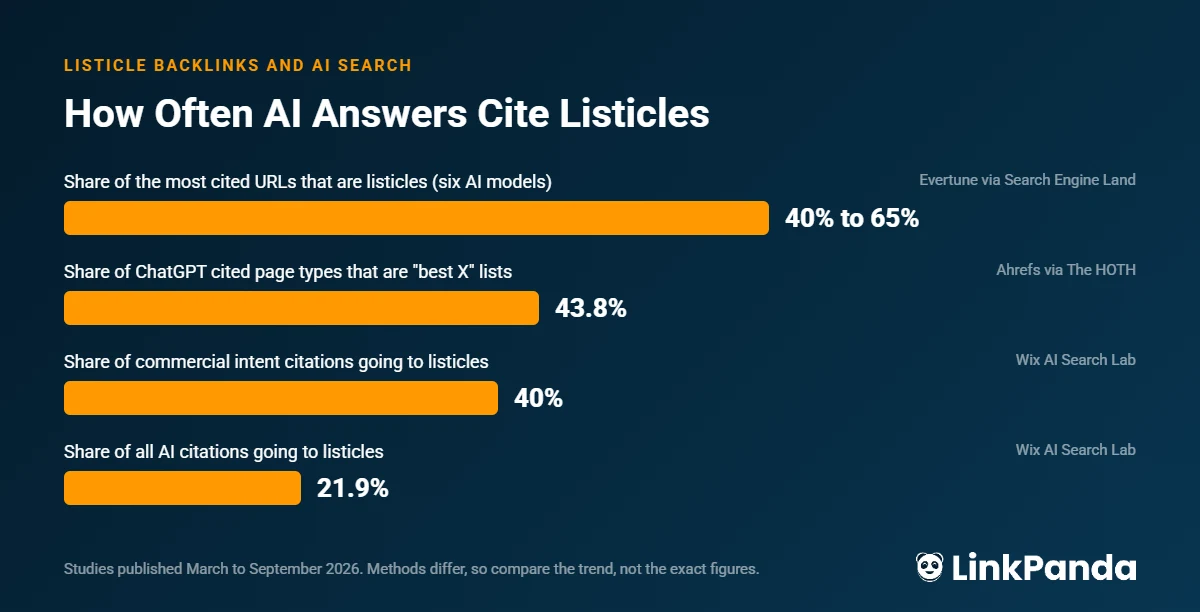
In practice this means that when a buyer asks an AI assistant for “the best [category] tool for [use case]”, the answer is often built from a handful of third party lists. If your brand is on those lists, you have a real chance of being recommended. If it is not, you usually are not mentioned at all.
We cover the wider picture in our playbook for getting cited in ChatGPT and Perplexity and our guide to link building for AI Overviews.
They Reach Buyers at the Decision Stage
People who search “best [category]” are usually close to choosing. A listicle backlink sends you referral visits from buyers who are already comparing options, which tends to convert far better than traffic from general articles.
They Build Authority and Referring Domains
Listicle backlinks are still backlinks. Each placement on a new site adds a referring domain, and placements on well ranked, well linked lists pass real authority to your site.
What the Research Does Not Say
Listicle backlinks are not a guaranteed shortcut, and the data has some important limits.
Results vary by category and by AI tool. One retrieval study of 291,607 ChatGPT citations on a B2B SaaS prompt set found the listicle share of citations fell from 6.0 percent to 1.0 percent between October 2025 and August 2026.5 Different studies use different prompts and methods, so treat the headline numbers as a direction, not a promise.
Self-promotional lists are also under pressure. Lily Ray’s research found that when a B2B brand ranks itself first in its own “best [category]” list, Google’s AI Overviews often cite the list but recommend another company.6 Some sites leaning on this tactic saw visibility losses of up to 49 percent after Google’s January 2026 changes.7
Important: The listicle backlinks that hold their value are on independent, editorial lists that rank and get cited. Treat lists published by vendors about themselves as lower value, even when they rank today.

What Makes a Strong Listicle Backlink
Two listicle backlinks can look identical in a report and be worth very different amounts. These are the factors we check before accepting a placement.
| Factor | Strong placement | Weak placement |
|---|---|---|
| Page ranking | Page one for the “best X” search buyers use | Not ranking for any buyer search |
| AI citations | Cited by ChatGPT, Perplexity or AI Overviews | Not cited anywhere |
| Position on the list | Top five entries | Buried at the bottom of a long list |
| Description | Accurate, specific, says who you are for | One generic line |
| Link | Followed link to your homepage or product page | No link, or link to the wrong page |
| Freshness | Updated in the last 6 to 12 months | Untouched for years |
| Site quality | Real editorial site with organic traffic | Thin site built to sell placements |
| Relevance | List in your exact category | Loosely related or off topic list |
At LinkPanda we set a minimum Domain Rating of 40 for listicle placements, use branded anchors, and aim for a top five position. If you want to check how your anchors look across all your links, try our free anchor text checker.
Case Study: Meera.ai Doubled Its Referring Domains
Meera.ai, an AI texting and SMS marketing platform, wanted to be seen as a serious option in a crowded category. We ran a focused listicle and category campaign, targeting lists such as “Best AI Texting Platforms” and “Top SMS Marketing Tools”.
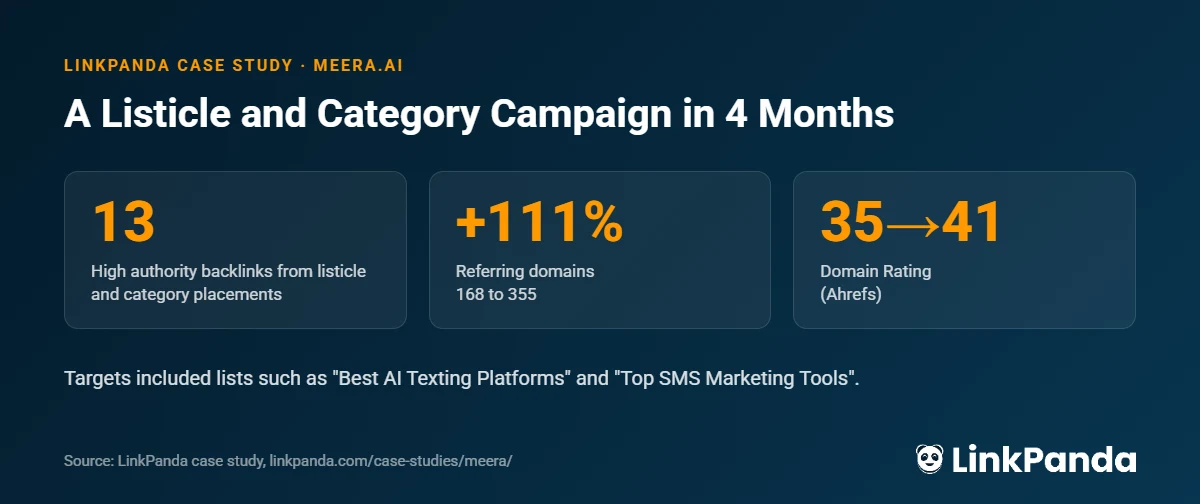
In four months the campaign delivered:
- 13 high authority backlinks from listicle and category placements.
- Referring domains up 111 percent, from 168 to 355.
- Domain Rating up from 35 to 41.
Read the full Meera.ai case study. For an AI search example, our Blank Spaces case study shows how 10 listicle placements grew AI citations 15x, from 10 to 151, in one quarter.
How to Get Listicle Backlinks
There are three main routes, and most brands use more than one.
1. Outreach to Existing Lists
Find the lists that already rank or get cited for your category, then pitch the writer to add you. This is the most reliable route for most brands. Our guide to listicle outreach walks through it step by step, and our guide to listicle sites shows how to find and score targets.
2. Relationships With Publishers
Writers who cover your category publish new lists every year. Being helpful when they need product details, screenshots or expert quotes makes you an easy choice when the next list goes out.
3. A Managed Listicle Service
Outreach takes time, and response rates are low without existing relationships. A listicle link building service gives you access to publishers who are already open to adding relevant brands, with placements vetted for quality.
Get Featured on Listicles That Rank
Handpicked placements on DR 40+ sites, branded anchors and every link tracked in your LinkPanda App.
What to Look for in a Listicle Link Building Agency
The best listicle link building agency is the one that can show you the actual lists it has placed clients on, not just a DR range on a sales page. Before you commit, ask for three things: live listicle placements in your niche, evidence those pages rank or get cited by AI tools, and a clear process for how your entry gets written and approved.
LinkPanda runs listicle placements as a standalone service, pitching brands into existing “best of” articles on real, editorially managed sites. The Meera.ai case study above came out of that exact process. Whoever you hire, if they cannot name the lists, treat the offer as a guess.
How to Measure Listicle Backlinks
Track each placement on four levels:
- Live and indexed. Check the link is live, followed and the page is indexed.
- Referral traffic. Watch visits from each list in your analytics, and the leads or signups they bring.
- Rankings of the list. Track whether the list still ranks for its target search.
- AI mentions. Ask AI tools your buyers’ questions each month and record whether your brand appears and which sources are cited.
Every link we build appears in the client’s LinkPanda App link tracker, so you can see each placement and check it whenever you like.
Final Thoughts
Listicle backlinks do two jobs at once. They build authority like any good backlink, and they put your brand on the shortlists that buyers and AI tools rely on.
Focus on independent lists that rank and get cited, aim for a strong position and an accurate description, and track every placement over time. Done that way, a small number of listicle backlinks can do more for your visibility than a large number of ordinary links.
Frequently Asked Questions
LinkPanda Link Building: Frequently Asked Questions
External Sources

Wix Studio AI Search Lab The content types most cited by LLMs
Analysis of 75,000 AI answers and over 1 million citations across ChatGPT, Google AI Mode and Perplexity.
Search Engine Land AI citations favor listicles, articles, product pages: Study
Coverage of the Wix study, including the 40 percent share of commercial intent citations that went to listicles.
The HOTH Why AI Cites Listicles More Than It Cites You
ChatGPT citation analysis, including Ahrefs data showing best X lists made up 43.8 percent of cited page types.
Search Engine Land AI search loves listicles: What 25,000 URLs reveal about citations
Evertune review of the 6,000 most cited URLs per model across six AI models, finding listicles made up 40 to 65 percent of them.
Discovered Labs ChatGPT stopped citing listicles
Retrieval study of 291,607 ChatGPT citations on a B2B SaaS prompt set, where the listicle share fell from 6.0 to 1.0 percent.
Search Engine Journal Why Calling Yourself the Best Could Be Helping Your Competitors Win in AI Search
Lily Ray’s study of 100 B2B best category queries in Google AI Overviews and how self-promoting listicles are treated.
The Digital Bloom GEO Traffic Optimization Report 2026
Report on how practitioners use self-published listicles and the January 2026 pressure on self-promotional lists.
About The Author

Christopher Lier
Christopher is an experienced Search Engine Optimization (SEO) marketer and digital marketing specialist. He is Co-Founder of LinkPanda and leads the marketing and sales teams. Mostly known as a Software-as-a-Service co-founder of LeadGen App, he has helped grow the website to become a renowned player in the lead generation space with steadily growing user base and readership.
You May Also Like
Brand Mentions for SEO: How to Earn More for AI Search
Link Reclamation: How to Find and Recover Lost Backlinks
Best Link Building Tools for 2026 (Reviewed and Compared)
Backlinks vs. Referring Domains: The Metric That Actually Predicts Rankings
How AI Overviews Are Rewriting the Rules of Link Building in 2026
Link Building for Fintech: The Sub-Vertical Playbook (2026)
Link Building in 2026: 34 Stats From Real Data
Parasite SEO: What It Is, How It Works, and Whether You Should Use It
SEO Without Link Building: Is It Possible to Rank Without Links?