Listicle sites are the websites that publish “best X” and “top X” roundups, such as “10 Best CRM Tools for Startups” or “Top Payroll Software for Small Businesses”. Getting your brand onto the right ones puts you on a buyer’s shortlist, earns you a backlink, and increasingly decides which brands AI tools recommend.
The hard part is not finding listicles. There are millions of them. The hard part is finding the listicle sites that actually rank, get read, and get cited, and then skipping the rest.
This guide covers the main types of listicle sites, five ways to find them, a simple scoring method, and the mistakes that waste most listicle budgets. It is based on the process our team uses for listicle link building campaigns at LinkPanda.
Key Point: Judge a listicle site by the page, not the domain. A DR 80 site with a list that nobody finds is worth less than a DR 45 site whose list ranks first for the search your buyers type.
What Are Listicle Sites?
A listicle site is any website that publishes list articles comparing products, services or companies in a category. The list is usually ranked or grouped, and each entry gets a short description and a link.
Listicles have been around for as long as blogs. What changed is who reads them. Buyers still use them to build a shortlist, but AI search tools now read them too, and they lean on them heavily when someone asks for a recommendation.
A review of the 6,000 most cited URLs per model across ChatGPT, Copilot, Gemini, Google AI Mode, Google AI Overviews and Perplexity found that listicles made up 40 to 65 percent of them.1 For commercial searches the pattern is even clearer: In a Wix study of 75,000 AI answers, listicles captured 40 percent of commercial intent citations, nearly double any other format.2
So when we talk about listicle sites, we mean the publishers whose lists sit between your buyer and their decision, whether that buyer is a person or an AI assistant reading on their behalf.

The Main Types of Listicle Sites
Not every listicle site works the same way. Knowing the type helps you decide how to approach it and what a placement is worth.
| Type | Examples | What a placement gives you | How to approach |
|---|---|---|---|
| Large publishers and media sites | Business, tech and consumer magazines | Strong authority, brand exposure, frequent AI citations | Editorial pitch to the writer, slow and selective |
| Niche industry blogs | Marketing, HR, finance or developer blogs | Highly relevant readers and links | Direct outreach to the author or editor |
| SaaS and company blogs | “Best alternatives” and “top tools” posts | Buyers comparing tools in your category | Outreach, partnerships, sometimes a paid listing |
| Review and comparison sites | Software review and comparison hubs | High intent traffic, trust signals | Profiles, reviews and sponsored options |
| Local and regional roundups | “Best [service] in [city]” pages | Local visibility and calls | Outreach to the local publisher |
Most strong campaigns mix several types. Large publishers bring authority, while niche blogs and company blogs bring the most relevant readers and are far easier to get onto.
One type to treat with care is the self-promotional list, where a vendor ranks its own product first. Research by Lily Ray found that Google’s AI Overviews often still cite these lists but recommend a different company instead.3 Some sites that relied on self-promotional lists also lost visibility after Google’s January 2026 changes, with documented losses of up to 49 percent.4
Important: A spot on a competitor’s own “best tools” list is still worth having if the page ranks and you are described fairly. Just do not count it as an independent recommendation when you plan your campaign.
How to Find Listicle Sites in Your Niche
Start with the searches your buyers type, not with a list of websites. The listicles that matter are the ones that show up for those searches.
1. Search Google for Your Category Keywords
Search the phrases a buyer would use, such as “best [category] software”, “top [category] tools”, “[competitor] alternatives” and “best [service] for [audience]”. Note every listicle on page one and page two.
Use a few search operators to go deeper:
- intitle:”best” [category] finds pages with “best” in the title.
- intitle:”alternatives” [competitor] finds alternatives roundups where you can be added.
- “[competitor 1]” “[competitor 2]” best finds lists that already include your rivals but not you.
- inurl:best [category] 2026 finds lists updated this year.
2. Check Which Lists AI Tools Already Cite
Ask ChatGPT, Perplexity and Google AI Mode the questions your buyers ask, such as “What is the best [category] tool for [use case]?” Then open the sources each answer cites.
These lists are the most valuable listicle sites you can target, because they already shape the answers your buyers see. They are not always the same as the pages ranking in Google. Ahrefs data shows the overlap between AI Overview citations and top 10 rankings fell from 76 percent to 38 percent in under a year.5
3. Look Where Your Competitors Are Featured
Run your main competitors through a backlink tool and filter their referring pages for words like “best”, “top”, “alternatives” and “vs”. Every list that includes two or three of your competitors but not you is a warm target.
Our free Backlink Placement Finder helps you spot placement opportunities, and our guide to backlink gap analysis walks through the competitor method step by step.
4. Search Content Discovery Tools
Tools such as Ahrefs Content Explorer let you search for pages with “best [category]” in the title and sort them by organic traffic. This surfaces lists you would miss in a normal Google search, including lists ranking in other countries.
5. Mine Lists of Lists
Publishers often link to other roundups from their own lists, and industry newsletters share them. Once you find one strong listicle site, check who it links to and who links to it.

How to Judge Whether a Listicle Site Is Worth It
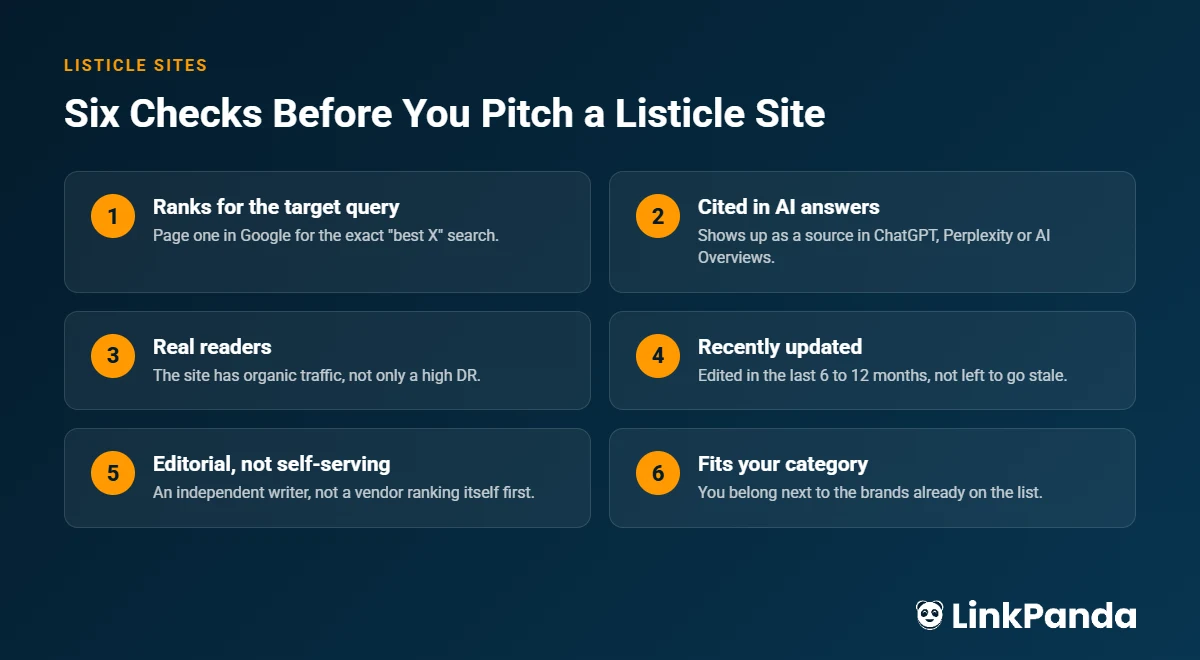
Once you have a long list, score each page before anyone sends an email. We use six checks.
| Check | What to look for | Why it matters |
|---|---|---|
| Ranks for the target query | Page one in Google for the exact “best X” search | Ranking lists send buyers and get read by AI tools |
| Cited in AI answers | Shows up as a source in ChatGPT, Perplexity or AI Overviews | The list already shapes recommendations |
| Real readers | Organic traffic to the page, not only a high Domain Rating | Authority without readers rarely moves anything |
| Recently updated | Edited within the last 6 to 12 months | Stale lists drop in rankings and get replaced |
| Editorial, not self-serving | An independent writer, not a vendor ranking itself first | Independent lists carry more weight with readers and AI |
| Fits your category | You belong next to the brands already listed | A good fit gets accepted and converts |
You can check Domain Rating quickly with our free Domain Rating checker. Treat it as one signal, not the deciding one. At LinkPanda we set a minimum of DR 40 for listicle placements, then judge everything else at page level.
Position also matters. Being listed fifth on a list of ten gets far more attention than being listed twentieth on a list of thirty. On our managed campaigns, placements typically land in the top five.
Case Study: 10 Listicle Sites, 15x More AI Citations
Blank Spaces, a digital wellness app, came to us wanting to show up when people asked AI tools for screen time and app blocking recommendations.
Over one quarter we secured placements on 10 listicle sites, with an average Domain Rating of 68 and a range from DR 43 to DR 91. Every site was chosen with the checks above, so each list either ranked for a buyer search or was already being cited by AI tools.
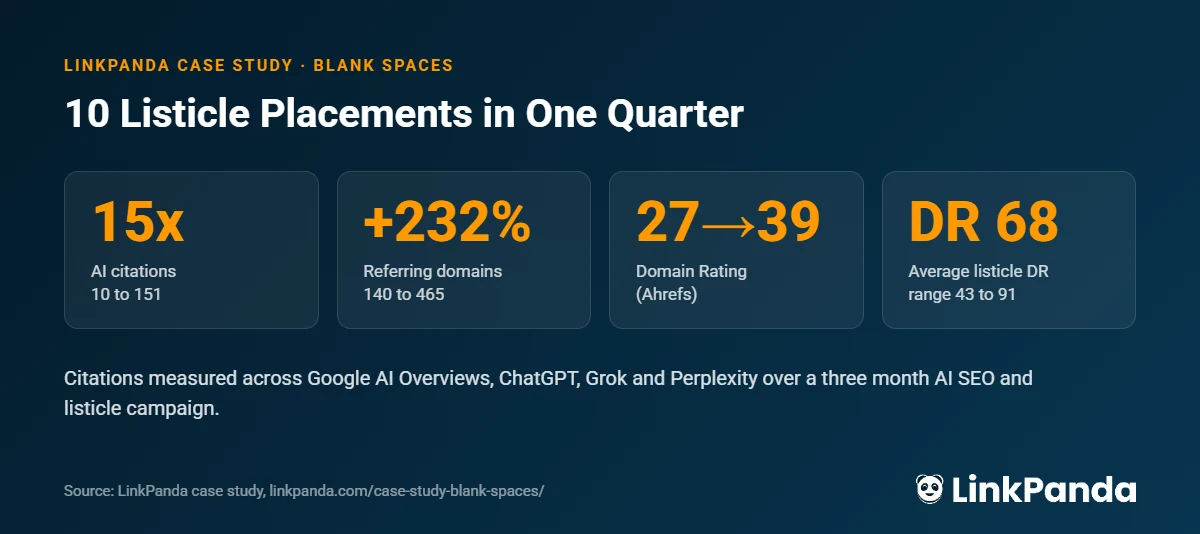
The results over the three month campaign:
- AI citations grew 15x, from 10 to 151 across Google AI Overviews, ChatGPT, Grok and Perplexity.
- Referring domains grew 232 percent, from 140 to 465.
- Domain Rating rose from 27 to 39.
You can read the full story in the Blank Spaces case study.
Common Mistakes When Choosing Listicle Sites
Choosing by Domain Rating Alone
High DR sites with lists that nobody reads are the most common waste of budget. Always check whether the specific page ranks and has traffic.
Pitching Lists That Do Not Fit
An HR tool on a list of project management apps rarely gets accepted, and readers skip it if it does. Stick to lists where your product is a natural option.
Ignoring How Old the List Is
A list last updated three years ago may still rank today but is likely to be rewritten or replaced. Prefer lists updated recently, or pitch the editor at the moment they refresh it.
Counting Every List the Same
A placement on the list AI tools cite most for your category can be worth more than ten placements elsewhere. Rank your targets so the best ones get the most effort.
Forgetting to Track Placements
Lists change. Entries get dropped, positions shift and links get removed. Keep a record of every placement, its position and whether it is still live.
How to Get Featured Once You Have Your List
Finding listicle sites is step one. Getting onto them takes outreach: Finding the right writer, giving them a clear reason to add you, and making it easy to say yes. Hunter, the email finder tool, built 96 links in three months this way, and found the best replies came from the editors and writers who created each list.6
We cover the full process in our guide to listicle outreach, and explain how these links compare with other backlinks in our guide to listicle backlinks.
If you would rather skip the research and outreach, our listicle link building service handles it end to end. We find the lists that rank and get cited, secure your placement, and report every link in your LinkPanda App link tracker.
Want Your Brand on the Lists Buyers Read?
We find the listicle sites that rank and get cited by AI, then secure your placement with a link.
Final Thoughts
The best listicle sites are not always the biggest. They are the ones whose lists rank for your buyers’ searches, get cited by AI tools, and are kept up to date by a real editor.
Build your list from buyer searches and AI citations, score each page with the six checks, and put most of your effort into the few lists that shape decisions in your category.
Frequently Asked Questions
LinkPanda Link Building: Frequently Asked Questions
External Sources

Search Engine Land AI search loves listicles: What 25,000 URLs reveal about citations
Evertune review of the 6,000 most cited URLs per model across six AI models, finding listicles made up 40 to 65 percent of them.
Search Engine Land AI citations favor listicles, articles, product pages: Study
Coverage of the Wix study, including the 40 percent share of commercial intent citations that went to listicles.
Search Engine Journal Why Calling Yourself the Best Could Be Helping Your Competitors Win in AI Search
Lily Ray’s study of 100 B2B best category queries in Google AI Overviews and how self-promoting listicles are treated.
The Digital Bloom GEO Traffic Optimization Report 2026
Report on how practitioners use self-published listicles and the January 2026 pressure on self-promotional lists.
Quattr Takeaways from the Ahrefs AI search studies
Summary of Ahrefs research, including the drop from 76 to 38 percent of AI Overview citations that also rank in the top 10.
Ahrefs Listicle Outreach: How Hunter Built 96 Links in 3 Months (Case Study)
Hunter’s listicle outreach case study, covering target types, contacts and email examples.
About The Author

Christopher Lier
Christopher is an experienced Search Engine Optimization (SEO) marketer and digital marketing specialist. He is Co-Founder of LinkPanda and leads the marketing and sales teams. Mostly known as a Software-as-a-Service co-founder of LeadGen App, he has helped grow the website to become a renowned player in the lead generation space with steadily growing user base and readership.
You May Also Like
Brand Mentions for SEO: How to Earn More for AI Search
Link Reclamation: How to Find and Recover Lost Backlinks
Best Link Building Tools for 2026 (Reviewed and Compared)
Backlinks vs. Referring Domains: The Metric That Actually Predicts Rankings
How AI Overviews Are Rewriting the Rules of Link Building in 2026
Link Building for Fintech: The Sub-Vertical Playbook (2026)
Link Building in 2026: 34 Stats From Real Data
Parasite SEO: What It Is, How It Works, and Whether You Should Use It
SEO Without Link Building: Is It Possible to Rank Without Links?